
Message of President-Comandante Daniel
on the 43rd Anniversary of the Great National Literacy Crusade
March 23rd 2023
Beloved Nicaraguan Brothers and Sisters, beloved Families, beloved Students, Teachers, in the different municipalities, the different areas of our country. Schools are multiplying to impart the basic learning that allows us always to prevent and keep at bay the virus of illiteracy. Because it is a virus all over the world, even in developed countries there are statistics where there are groups of young people or adults, who because conditions of poverty exist in developed countries, despite so much wealth there is also poverty, there is also misery.
Even there, these times repeat what Rubén Darío saw when he walked through New York City , with as he said, 50-story houses, as he admired the wealth of the United States; and he said, but what is sad, my God, is to see there under the bridges those who die of cold. Because the winters there are terrible and they kill those families who live under the bridges and who eat from the garbage cans, from the leftovers that get thrown into the garbage cans. People who die, my God, said Ruben Dario, of pain, pain and more pain.
Yes, illiteracy is a disease, a virus that is caused by the capitalist system. There lie the causes. A system made to make the rich richer and the poor poorer, one where it is not a priority to eradicate poverty or extreme poverty or illiteracy, but, quite simply, a system that has been imposed on the world, a system that has been overcome in many countries, in many nations, and here in Nicaragua we confronted this virus with the Triumph of the Revolution. There was no other possibility! Only with a Revolution could literacy be achieved, otherwise it was to continue with the darkness of illiteracy.
When the Revolution triumphed the Nicaraguan economy, the Nicaraguan economy was in very good shape, indeed, all the economic indexes of the international organizations gave Nicaragua a very good economic rating; back then the European countries, the United States, applauded Nicaragua's government, because it had very good economic conditions.
But the illiteracy Rate was around 60%, that is, out of every 100 Nicaraguans, 60 could not read or write. Something really monstrous, but for capitalism it was regarded as something normal. The more illiterate people, the better, say the capitalists, because we will have more cheap labor. Because it is the poor who need to work, and the rich who want to pay as little as possible; for them, if more workers are poorer then for us they'll be more willing to earn whatever we want to pay them. At that time they didn't care about illiteracy, it was not even mentioned as a social disease.
The Revolution triumphed and we set out to fulfill that historic objective that comes from our ancestors; from our ancestors who populated these lands and who had their own cultural development, had their own languages, had their manner of building houses according to the economic and social reality in which our ancestors lived.
That's where all of us come from, as Darío said, as Sandino said: Indigenous blood runs through our veins; yes, it was mixed with Spanish blood, it was mixed with European blood, the Europeans who came to our countries, apart from the Spaniards, French, Italians; that blood was mixed with US people's blood, the US citizens who came to our countries, and that mixture came about, that miscegenation, where, while it is true that we speak Spanish, inside we have the grit, the strength, the culture and the pride, the courage, the nobility of our indigenous ancestors, because they really were men and women proud of their culture, their values, their religion.
Nor do we forget that, when we started the struggle, those of my generation, because the struggle has been permanent in Nicaragua, Nicaragua's People have always fought, from Diriangén, Nicarao and all the indigenous Peoples who fought, who gave their blood, who gave their lives; the indigenous peoples who have managed to keep their language, thank God, especially the Peoples of the Caribbean, of the Caribbean Communities, the Misquitos, the Mayagnas, the Ramaquíes.
The maestro has just been, I saw you, Maestro, in the activity, all of you were in the activity, on the little island, that little island we have visited with Maestro Pineda several times, the little island that is there on the shore of Bluefields, you can only go by boat to get to that island, and the island is the headquarters, it is the birthplace of the Ramaquíes, whose territory extends also along the coast is opposite the island, that is also the land of the Ramaquíes, which is land that belongs to them and that right now they have their legal Title they have their Deed, as we say... There you are, I have the deed to my house, now I can rest calm.
They now have the legal deed of their lands, and while maintaining their language, their own language, they are also learning to master Spanish. And because this is a multicultural country, there are also Garífuna sisters and brothers and there are also black, Afro-descendant, proudly black, English-speaking communities. English, not because it is their language, but because they were slaves of the English.
Just as they were slaves of all Europeans, those who were slaves of the English had to learn English at the point of a whip. They were treated as a commodity, as an object. They were bought and sold! That cannot be forgotten, how the Europeans went to buy slaves to Africa, how they arrived at the markets where whole families were, made captive by the slave traders, the families there, in chains, and the traders arriving to select the merchandise.
And there you had mothers with children, with children, all were slaves. And that European, very cultured and very civilized, setting about buying those lives, and examining them, to see if they were sick or not, if they had fractures; that is, complete brutality, practiced by those who call themselves the “great parents of civilization.”
We cannot imagine the "parents of civilization” buying human beings, putting them on the ships where the slaves crossed from one Continent to another, passing from Africa to Europe, and from Europe to the United States because there they needed a slave labor, and the trade from the United States to the coasts of Africa to Europe, and from Europe to the Caribbean, where the islands were dominated by the British, by the French, by the Dutch.
Yes, there were those slaves, working for whom? For the rich, for the rich Europeans who had appropriated those lands as well. And those people didn't dream of reading, they didn't have the right to read there, they didn't have the right to learn, because if they were given knowledge then that was already to give them power. Millions of slaves were thus sacrificed by the so-called “civilizers”.
Well, here too, these Caribbean Peoples, as I was telling you, are Peoples who have managed to maintain their language, speaking several languages, they speak Spanish, they speak English too, because English is also spoken on the Coast; that is to say, circumstances have allowed them to master several languages without having to go to school. How so? Because in everyday life they cohabit.
But then too we also promote literacy in different languages, what for? So that with that with the language that they already mastered spontaneously they could also now have more solid knowledge and go further with that knowledge so as to be able to excel at school. And we also created schools there for the indigenous populations, for the Original Peoples.
I was telling you that, at that moment, an essential human right was being fulfilled: The Right to Knowledge. A human being without knowledge is simply a slave of ignorance, and if they are a slave of ignorance then they are a slave of exploitation.
On the other hand, knowledge gives human beings power: Power to communicate, power to learn about history, science, biology; to be able to learn about humanity, civilizations, religions; to be able to know about slavery, to condemn and denounce it wherever situations of slavery still occur.
Power, for what else? To be able to make more of oneself, and with that advance to help make more too of the family, economic, social advancement, so as to have a dignified life, to be able to have employment, to be able to have a profession; in other words, that is a right that was achieved by the triumph of the Revolution, and it starts with literacy, because how could a boy, a child, or an adult go to school, if they could not read and write? Literacy first! And it was an extraordinary campaign.
In the early days of the Sandinista Front, I remember here, we high school boys and girls, organized in the Revolutionary Student Front that brought together high school students and university students, well, here we organized mini literacy campaigns in the neighborhoods.
In Acahualinca, I remember, we were went to promote literacy, and also to the Los Pescadores neighborhood, to all these impoverished neighborhoods in those areas of Managua, there teaching literacy.
I remember that my father, a Sandinista, also took the initiative to create a literacy method and, as well he could, got help to print literacy primers, and he began to promote literacy for the first time in the history of Nicaragua by radio. And we were literacy teachers who, with guidance by radio, were literacy teachers there in the neighborhoods. But, of course, that was not to the liking of the Somoza dictatorship and ordered the program to be closed.
And being in Pancasán, I remember, in 1967, there in the Matagalpa cordillera, the two great mountain ranges go, the Dariense cordillera, and the Isabelia cordillera, they cross there, and then the cordilleras that run along the border with Honduras, there on that mountain we installed a guerrilla encampment to give continuity to the struggle that our People had been waging since the conquistadors arrived. From that moment on, people began to fight here for the rights of the poor, for the rights of the People.
And peasants began to arrive to join the guerrilla, most of the Sandinista Front militants; there in Pancasán, well, there was our Comandante Carlos, from Matagalpa; there was also Comandante Silvio Mayorga, he was a professional, originally from Nagarote, and also, there was Comandante Borge, in Pancasán; Comandante Oscar Turcios was also there in Pancasán; there was compañera Gladys Báez, yes, there were women there, women could not be missing, compañera Gladys Báez, chontaleña, a country woman. There I encountered several chontaleños like myself.
There was also, among others, Francisco Moreno, the son of a doctor, but we had worked together since high school, and he also joined the Pancasan guerrillas. Francisco Moreno, whom we called the "Chele Moreno”, because he was chele, totally chele, with blonde hair, completely chele, and with the surname Moreno, so then ”Chele Moreno" was what we called Francisco Moreno.
Rigoberto Cruz, a great comandante, originally from my town, La Libertad, Chontales, was also in that Camp; Edmundo Pérez Flores, another brother!
So, everyone was already very experienced, having already been imprisoned many times; we are talking about the year 1967. We had already had the first experience of Raití and Bocay. Many brothers, like Jorge Navarro, founders of the Sandinista National Liberation Front, had already fallen in the fighting.
And being there in the mountains, and incorporating peasants from the area, the peasants who arrived were mostly young, others a little older, and they couldn't read or write. So then it occurred to “Chele Moreno”, as he had had an internship here, we were doing literacy here in the city, he thought about that, and so it occurred to him to grab one of the Peasants: Come, do you want to learn to read and write? Can you read? “No”. He sat down with him and started teaching him. Then another joined in.
Carlos didn't know what they were doing, and Carlos passed by and when he saw them there, he asked: And what are you guys doing? Then, “Chele" told him, it's that they can't read or write, so we are here teaching them. That's when Carlos said: Teach them to read, yes, teach them to read as well.
And this miracle became possible with the triumph of the Revolution. And how the youth joined in! There were thousands of men and women, teachers, and thousands of young people, boys and girls like you, yes, just like you! You can see the TV footage of what the Literacy Crusade was like, the moments when they were held mass meetings in the Plaza here, the time when they were leaving in the trucks. It was called the National Literacy Army, and there was this Teacher, this Maestro, just a boy then, but there he was at the head of the contingent of literacy teachers.
And it was an explosion of Joy, an explosion of Solidarity, an explosion of Love for Christ! Because Christ said that, "Love your neighbor as yourself." He said, so if you see your neighbor can't read and write, the way to show love form them is by teaching them to read and write. And the miracle happened, and too the blows, the tragedies; the evil.
Because the Campaign started on a day like today, March 23, with April a month, up to May 18, we would be talking about a month and 18 days. A month and 18 days later, the enemies of the impoverished, the enemies of the poor, the enemies of the People, the enemies of Literacy, organized and encouraged by the Yankee Government and also by the oligarchic groups that had escaped the triumph of the Revolution, who were already organizing counterrevolutionary armed groups, at that moment from Honduras they murdered the first literacy teacher: Georgino Andrade, a Hero of Literacy!
Remember, Georgino didn't carry a weapon, as the Hymn says, it was books, notebooks, pencils that were the weapons of the Literacy Teachers; and Imperialism hates these weapons when they are in the hands of the People, when they are in the hands of the peasants, when they are in the hands of the poor, such that they have a multiplier effect to lift a People out of ignorance.
They wanted Nicaragua crushed, dominated, and in order to dominate it better and enslave it better, it was not convenient for the People to learn to read and write. And by murdering Georgino they thought they were going to sow terror and panic among the Literacy Teachers. But it wasn't like that. They provoked more indignation against them, they caused greater commitment among the Literacy Teachers, who multiplied as more Literacy Teachers were added.
In this way the National Literacy Crusade was the first great victory of the Nicaraguan People in its entire history. The first great victory opening the way to Freedom, opening the way to Justice, to Solidarity. It was the first big victory, and since then we have not let it lapse.
Of course, we have managed to develop education programs so that all young people in the city and in the countryside have free education; so that families who have more difficulties for their children to go to school can be assured of a school meal; so that programs can also be developed beyond primary and secondary education, at the same time also developing these other programs so that they multiply learning so as to achieve greater performance in all the intellectual, productive activities of our country.
In this way peasants are also incorporated into education to improve the yield in coffee production; farmers and ranchers too. Education is brought to young people in remote areas, and there too we have person-to-person education, either on television, or with all the programs that are now being developed virtually.
There are dozens of programs multiplying learning and helping young people also to develop the knowledge for creating ventures that give them the possibility of setting up their own business; a business of their own that eventually becomes a bigger business and strengthens them economically and socially; because that is the way to democratize the economy.
Every human being, every young person has the right to have their business, to set up their venture. And there are young people who not only work but also have their own small business, one that is already giving them autonomy and independence to have their own resources, and their small business is complemented by the salary of the place where they work.
And, as I was saying, while still keeping up the search for places, communities where there may be illiteracy, because it's true, we achieved literacy, but then we had to do a second big campaign because illiteracy had grown, it had multiplied in the period we were out of government. From 1990 to 2007, illiteracy grew again in Nicaragua, because there were governments that were not there to serve the people.
And when we returned to Government we had to initiate a new Literacy Crusade; I remember that we made many televisions available to go to different places teaching literacy with the television there, so as to use video cassettes, it was easier for young people or adults who were learning so they could acquire knowledge more quickly; and even taking the system to places that already had achieved literacy, affording better learning like the system you installed there on the island with the Ramaquíes, just 15 days ago, Maestro.
Who would have imagined that any government would be interested in the Ramaquí People, or in the Coco River, all the communities of the Coco River where Maestro Pineda has also been developing programs, together with the Ministry of Education.
So we must stay alert in the cities, in the countryside, wherever we find a focus of illiteracy, immediately attack it, so that those young people or those adults who are illiterate, with learning may be able to have the instruments, the weapons to be able to develop, to be able to live better.
Also to be able to participate in learning business skills, because if they do not know how to read or write they will not be able to participate in courses to learn business skills. Once they have basic knowledge they can participate, and then with business skills, receiving training, they can develop better still; if they have a small business they will develop better, a peasant, a worker who has a small business, will develop it much better with the skills that we are imparting everywhere; so that producers can achieve better performance and so that people with small, medium and large businesses can achieve a better performance in their activities.
So, we have to continue to be alert for when we have a focus of illiteracy immediately go, like firefighters, to put out that focus of illiteracy. And we are sure that all of you, young people, are aware of the value of learning, the value of education, and therefore have the heart ready to love your neighbor as yourself, and thus share your knowledge with those who are in more difficult conditions.
Well, congratulations to the students, to the men and women, the teachers, who have received this recognition today for having achieved greater performance, which does not mean that those who were also practicing teaching and are practicing education, and who are studying, that does not mean they do not perform well, of course they perform well, but it is always natural that there are measurements of higher performance and we must encourage those who give higher performance, so that those who do less well strive harder, and the harder they strive the more powerful they will be, because knowledge is the most important weapon that a person can have.
So we congratulate all these teachers, teachers who have done great work, I was telling them that they are going to send us a copy of the methods they have developed, which are creative, and we have to share this. All of you in the Ministry of Education have to increase sharing what these teachers are contributing.
And congratulations also to all your families, because without the support of the family things are more difficult, but with the support of the family then study becomes more stimulating for elementary students, for secondary students, for teachers.
So, we congratulate all you families, and we congratulate, of course, the directors of the schools where you have been working. And we also congratulate all our country's teachers, all the students of our Country, where you are above all an expression, you are very proof of the fruits of our country's solidarity-based and Christian education.
Long live the National Literacy Crusade!
Long live the students!
Long live the teachers!
Long live Nicaragua Blessed and Forever Free!
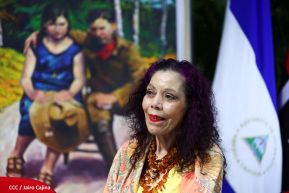
Remarks by Rosario, Vice President of Nicaragua,
after the event for 43rd Anniversary of the Great National Literacy Crusade
March 23rd 2023
Good evening. What a beautiful slogan that of the Literacy Campaign, expressing what we are, a People of Dignity... Raise your fist! A People making advances in education, in health care, in culture and in Peace! A people that overcomes! That's who we are, and we feel inspired, always, excited, when we make the journey along all the ways we have advanced. And too, we are always inspired and excited when we remember those who have given the best of themselves, their Life, so that we may live in Peace, so that we may live in prosperity... Working securely, living safely, and thriving!
It is very difficult for me to remember so much without being moved to tears, because really. all these times have been hard, but also full of light. Perhaps courage derives from facing difficulties. We have learned that, when it costs the most... "Whoever wants heaven, let them earn it." That's what we've been taught since we were little. And in those feats, in those challenges, that we take on in Honor and Glory, we know there too is the strength of our People, the strength of our Spirit, and the strength of our History, and all the enormous Dignity Nicaraguans have.
It is more than 4 decades since the epic of the Literacy Campaign, and now we are also going to celebrate 44 years of Revolution, which is what has made all these achievements possible. That's why we feel blessed. We thank God that we are here, always looking ahead, always with our minds set on the creation of the times to come, of that future, of all those dreams coming true, of so many, of so very many, of all Nicaraguans of all times.
So, for us, every day is a day of thanks to God. As Christians, as believers, as devout faithful, we know that Hope is there, blazing and getting stronger, so as to advance in work, security, prosperity, in blessings, and victories.
This is a day to celebrate life... We are always celebrating life! And a day for our heart, the heart that we put into everything we do, to become more and more committed to creating the future we deserve of Light, of Life, of Truth. Our destiny is that of being Sandino's children and we have turned Darkness into Light.
A beautiful journey for the Dignity of the families of our Blessed Nicaragua, always Sovereign and forever Free...! And We Go Onward and Always Beyond... with our fists raised up and our hearts, with our schoolbooks open!
A warm embrace, Compañeras and Compañeros. Thank you.