
Becca Renk *, Casa Ben Linder, 4 de mayo 2023
https://www.casabenjaminlinder.org/navigatingnicaragua/albagames
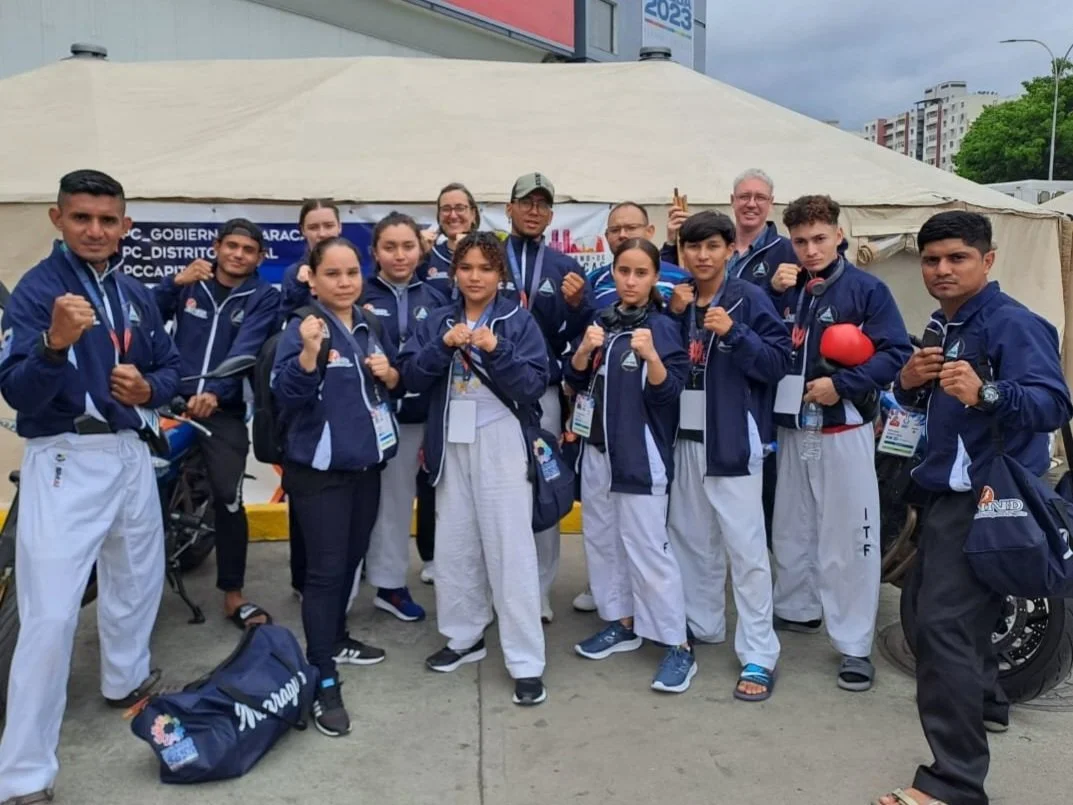
For the past five years, I have told foreigners visiting Nicaragua: "Don't believe the news about our country, you can see with your own eyes that what they say isn't true." Now I am in Caracas as part of the 568-person delegation from Nicaragua to the 5th ALBA Games, and every Venezuelan I speak to over my two-week stay repeats those same words. Both countries have suffered from US-led propaganda and economic coercive measures, and both have resisted.
ALBA
ALBA, the Bolivarian Alliance for the Peoples of Our America, was initiated nearly 20 years ago by Venezuela and Cuba as an alternative to the so-called free trade proposal by the US [the Free Trade Area of the Americas (FTAA) which was ultimately unsuccessful]. Rather than seeking to benefit big business, ALBA trade is based on complementarity, solidarity and cooperation. Members of ALBA currently have expanded to include Antigua and Barbuda, Bolivia, Dominica, Grenada, Nicaragua, Saint Kitts and Nevis, Saint Lucia, and Saint Vincent and the Grenadines.
The first ALBA Games were held in 2005 to unite the peoples of the region through friendship, cooperation and fraternity among athletes. The Games were held with great success every two years through 2011. Since Hugo Chavez' death in 2013, the Games have been suspended due to increased unilateral coercive measures (sanctions) against Venezuela, Cuba and Nicaragua and the COVID-19 pandemic.
ALBA Games 2023 in Caracas
This year, the Games are being held again in Caracas with delegations from all ALBA countries and Russia participating in 33 sports disciplines. My family is here as part of the 14-member Kenpo Karate martial arts team - our daughter Orla to compete, my husband and I as technical support.
Our participation in the Games was far from guaranteed - Kenpo is not a well-known sport in Nicaragua - we only have one school at the free municipal gym in Ciudad Sandino, just north of Managua, and our competitive experience has largely been within our own school.
In contrast, Kenpo is a popular discipline in Venezuela, but to be included in the Games, the participation of at least two countries is required. So, with the support of the Nicaraguan Sports Institute (IND), the Nicaraguan Mixed Martial Arts Commission (CONAMMIP), and the municipality of Ciudad Sandino, our instructor or sensei, Pedro Sánchez, was given the opportunity to bring a team to Venezuela to represent Nicaragua and include Kenpo in the Games.
Kenpo
I was 38 years old the first time I stepped into a dojo. I was working with a group of at-risk teenage girls and brought them to the municipal gym in Ciudad Sandino to the Kenpo class to learn basics of self-defense. We weren't expecting the class to have 50 students, and I could see the girls shrink inside when they saw how full it was. They shook their heads and whispered, "No, Profe, I can't do this."
"Nonsense," I told them, "If I can do this, you can." With a confidence I didn't feel, I lined up at the back of the class and the girls followed behind; I've been training ever since. I soon put my then 8- and 10-year-old daughters in the class, and we have now earned black belts.
At first, we trained barefoot on concrete tiles - running, kicking and falling on the hard floor - and competed bare-handed and without helmets. Thanks to investment in sports from the mayor's office, we now have safety equipment and practice on spongy tatami. We've seen how important the free classes are - many of our students get athletic scholarships to university and some of the best mixed martial arts (MMA) and kick-boxing fighters in the country come from our school. Now we have the opportunity to take ten of our best young athletes to Venezuela.
In Managua, all the sports teams are put on a direct flight to Caracas on Venezuelan state-owned airline CONVIASA. The plane is a sea of blue and white "Nicaragua" jackets, with everyone wearing our official uniforms and brand-new shoes. For most of our team, it is their first time on an airplane.
Upon arrival, we are greeted with traditional Afro-Caribbean drumming and taken to a five-star hotel - courtesy of the Venezuelan government - in the state of Miranda, a few blocks from the gym where we will compete. The hotel has 18 floors - four more than the tallest building in Nicaragua. Our team stands open-mouthed by the rooftop pool as brilliant blue and yellow parrots fly past at eye level.
"It's Been a Brutal Attack"
Venezuela flourished under the presidency of Hugo Chavez, who used profits from the country's oil production - the largest reserves in the world - to significantly improve the lives of the poor majority. Following Chavez's death and the election of his successor Nicolas Maduro, the U.S. ratcheted up its regime-change efforts against Venezuela, supporting an opposition who attempted to achieve by violence what they could not win at the ballot box.
In 2014 the Venezuelans suffered guarimbas which were violent road blocks run by thugs, along with looting, scarcity, and even deaths. The U.S. also began moving toward a full economic blockade; there are currently more than 920 unilateral coercive measures (sanctions) against Venezuela by the U.S. and other countries.
One evening we talk to members of the PSUV Youth. We lean in with interest as they speak, because we know U.S. regime-change efforts in Nicaragua have been copied from what has been used in Venezuela. The violent road blocks that paralyzed Nicaragua during the U.S.-led attempted coup in 2018 were similar to the guarimbas in Venezuela. As one man we met on the street said to us, "The U.S. gave you a dose of the same medicine they gave us here.”
While there are U.S. sanctions against Nicaragua currently, they have been less draconian than those that Venezuela has suffered in recent years.
"It's been a brutal attack," says Daniel Rivas of PSUV Youth. "It's been impossible to import medicines, people have died as a direct result of the sanctions. During the pandemic we weren't allowed to purchase the vaccines. These sanctions are a massive violation of basic human rights."
Refinement and sale of Venezuela's rich oil production has been severely limited by sanctions, strangling the economy. "We have oil, but we can't export it," explains Daniel. "It's like I've got a huge store full of clothing, but I can’t sell any of it because you’re blocking my doorway.”
The minimum wage in Venezuela is low, but costs of goods are similar to Nicaragua. To offset effects of inflation, the government has invented new ways to help its people:
--Venezuelans receive free or discounted gas at government outlets.
--Families receive a basic food basket.
--Water, electricity, public education through third level and public health care are all free.
--The government’s Patria system credits coupons or bonos which can be used to make purchases on a phone app. Bonos are assigned based on a family's needs (children, people with disabilities and elderly receive bonos) and for volunteer work carried out. For example, the nurses and doctors caring for our delegation are paid in bonos. Most Venezuelans get several bonos per month, some worth up to $45 each.
Thanks to these programs, Venezuelan families have most of their basic needs met. But as Venezuelans told us, they continue to struggle. As a result, much like in Nicaragua, Venezuelans take on other jobs to make ends meet. "We all do whatever we can," one teacher tells us, "We make jewelry, tortillas, resell clothing."
Competition and Cable Cars
The day of our competition is tough. Everyone is nervous, including me. The Venezuelan teams are well prepared and have the home court advantage. Orla does well with her form in weapons, but comes in third. Her fight is a close one, she lands good punches and solid kicks to her much older opponent, but she loses the fight by three points.
By the end of the competition, we haven’t won a gold medal, but our ten athletes receive fifteen medals: six silver and nine bronze, including Orla with two bronze medals. During the awards ceremony, the gold medal winner in her combat category chats with Orla, and they follow each other on Instagram. She invites Orla and the silver medalist up onto the first-place platform with her. Orla is thrilled with this treatment and says she'll remember it for when she wins a gold medal.
Once we've competed, we're rewarded with an outing by cable car to the top of the Warairarepano Mountain that looms over our hotel. Built in the 1950s, the cable car system was abandoned until the Chavez government nationalized and rebuilt it to benefit the public in 2007. Our group rides the cable cars on a free day for the community, and there are groups of school children. There is an incredible view of Latin America's most densely populated city on the way up, and at the top there is an ice rink, the best hot chocolate (basically warm pudding) and something called cachapas.
The hotel staff have recommended cachapas to us, so we eagerly gather around the stand. The owner is a young woman named Saileth, who explains to us that cachapas are tortillas made with fresh corn and filled with farmers cheese and pork. While we wait for our delicious cachapas, we chat with Saileth. She tells us she speaks four languages and has dual Spanish citizenship, but after a brief stint waiting tables in Perú, she says she doesn't see any benefit to leaving Venezuela.
"Here we have opportunities: we already have a motorcycle, soon we'll buy a car, and with what we can save over two years, we can buy an apartment that will be ours. In Spain, owning a home is an impossible dream."
What We Take with Us
After our competition is over, one afternoon we go to the gym nearby to train with the local sensei and his students. He puts us through the paces running drills, showing us techniques to get past an opponent with a high guard or who constantly kicks. Our team is thrilled; it's always invigorating to see different fighting styles.
The sensei has everyone gear up to spar. Orla spars for more than an hour with Venezuelan youth while the senseis show her how to best them using her long legs to reach and land a kick. At the end of the training, the kids crowd around, excitedly exchanging phone numbers so they can WhatsApp each other.
Even with 15 medals weighing down our bags, the most valuable thing we take home with us is the friendships - the nurse who gave me a bracelet made by her daughter, the youth representative who sends me links to Bolivarian Revolution videos, and the connections that the kids on our team make in Venezuela. In just two weeks, their world has expanded exponentially; their lives will never be the same again.
I will treasure the image of the two senseis, one Nicaraguan and one Venezuelan, sitting side by side on the mat; sweating and exhilarated from training, with matching glints in their eyes as together they coach my daughter sparring. For me, these two warriors passing their battle experience on to a new generation exemplifies the 5th ALBA Games. Ten years after his death, we are fulfilling Chavez's dream of a Latin America united.
* This article was first published in NicaNotes. Becca Renk has worked in sustainable community development in Nicaragua since 2001, and organizes study trips to Nicaragua through the Casa Ben Linder in Managua. If you are interested, contact her at <becca@jhc-cdca.org>. She lives with her family in Ciudad Sandino.