
Stephen Sefton, September 12th 2022
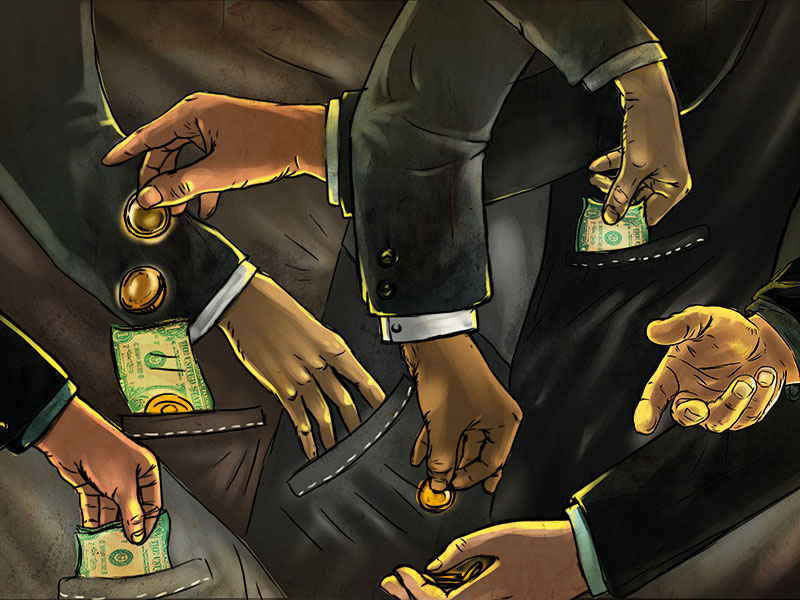
For many years, North American and European governments have manipulated and devalued the issue of human rights in an extremely cynical way in order to misrepresent and discredit governments that resist their will. Similarly, they have used the issue of corruption as just one more tool with which to attack governments, movements and leaders promoting policies that challenge the power, control and influence of the West. In Latin America, after the regional rejection of the 2009 military coup in Honduras, the United States and its allies have, in the most purposeful way, exploited human rights issues and corruption as axes of destabilization. They have added them as variants to those other old and worn-out axes of manipulation, namely, democracy and the free market, deployed since the Cold War years against the Soviet Union.
Historically, in Latin America, the United States and its allies have supported clearly criminal regimes, from the Somozas in Nicaragua, to the Duvaliers in Haiti, to Pinochet in Chile, among many others. Then, after the end of the Cold War at the beginning of the 1990s, it was no longer convenient for the United States and its allies to support regimes espousing anti-communism. They also believed that their regional control would prevent the emergence of progressive, much less revolutionary, governments through the electoral route. However, Comandante Hugo Chávez took power in 1998 in Venezuela, Jean Bertrand Arisitide in Haiti in 2001, Nestor Kirchner in Argentina and Lula da Silva in Brazil in 2003, in 2006 our Comandante Daniel Ortega in Nicaragua, Manuel Zelaya in Honduras and Evo Morales in Bolivia along with Rafael Correa in Ecuador, and, in 2008, Fernando Lugo in Paraguay.
The electoral victories of these progressive and revolutionary political forces, was a tremendous challenge for the imperialist powers, one which, at the beginning, the United States addressed in its usual way with coups d'état in Haiti in 2004, in Honduras in 2009 and failed coup attempts in 2002 in Venezuela, in 2008 in Bolivia and in 2010 in Ecuador. This is the context in which the United States was developing with its local allies the so-called “soft coups” with which they managed to displace President Lugo in Paraguay in 2012 and President Rousseff in 2016 in Brazil. So, without the application of its traditional military aggression or illegal coercive unilateral measures, often called “sanctions”, the United States managed to install regimes in Brazil and Paraguay more conducive to its regional interests.
In relation to the issue of corruption, in Latin America and the Caribbean the US has deployed several variants against the peoples of the region. On one hand, it is used to control right-wing figures associated directly or indirectly with networks of illicit or openly criminal activity, for example Otto Perez Molina in Guatemala or Juan Orlando Hernández in Honduras or, in Colombia, Álvaro Uribe Velez and Ivan Duque. This variant applies in cases where a government leader of an ideology acceptable to the United States assumes power but requires a measure of pressure to ensure their obedience. In this way the US and its allies maintain a blackmail-based relationship, menacing the people concerned and thus, in effect, exercise direct control over governments' economic and foreign policies.
Another variant of the abuse and manipulation of the issue of corruption can be seen in operation in Peru and to a lesser extent, for now, in Ecuador. In Peru, the country has been in a constant state of political turmoil for many years due to repeated cases of politically motivated accusations of corruption against its presidents. This situation has made it impossible for President Pedro Castillo to develop his government program in favor of the impoverished majority of the country, faced with a legislative power dominated by the right wing and national media also aligned with the right wing. This is another way to ensure that the country in question cannot develop a progressive electoral force capable of achieving power and implementing an effective national human development plan.
But perhaps the most notorious variant of the abuse of the issue of corruption by the United States to intervene in the internal affairs of Latin American countries is the variant that attacks the leaders of progressive political movements. Its objective is to sabotage the development of the electoral possibilities of these movements by means of false accusations amplified by the local dominant media to provoke rejection and hatred among voters. The most well-known cases of this abuse of the issue of corruption are those of Lula da Silva in Brazil, Cristina Fernández de Kirchner in Argentina and Rafael Correa and Jorge Glas in Ecuador. In effect, it is a campaign of abuse of the legal system, so-called “lawfare” or war through actual perversion of the course of justice, with the intention of destroying progressive electoral options which would take office in government were it not for the bad faith intervention of the judiciary.
The judicial attack against Lula da Silva is really the template of this distortion of justice engineered by the US authorities over the issue of corruption. It was part of the so-called Operation Lava Jato initially led by Magistrate Sergio Moro. Sergio Moro had been trained in the United States in courses offered by that country's Department of Justice. In 2020, evidence surfaced that Moro and other officials on the investigation secretly and illegally collaborated with the US authorities. In the same way that there was no trustworthy evidence against Lula da Silva, the current Vice President of Argentina has been persecuted for several years over spurious charges of money laundering based on the false suppositions and unjust arguments of politically motivated Argentine prosecutors.
In all these cases figures the abuse of the respective country's judicial system in order to mount aggressive political campaigns by means of the perversion of due process. The case against Cristina Fernández de Kirchner was initiated by the authorities of the corrupt previous administration of President Mauricio Macri. Undoubtedly, it will come to light later that the prosecutors in the case have been advised by the US authorities, just as in the judicial campaigns against Dilma Rousseff and Lula da Silva, which were developed closely not only with the US Department of Justice but also with the Federal Bureau of Investigation, the FBI. This was also true in the notorious case of the suspicious death of Argentine prosecutor Alberto Nisman in charge of the long standing case of the AMIA bombing. Likewise, the recent case of the Venezuelan plane hijacked in Argentina is further proof that, in Argentina, US law predominates over national jurisdiction.
One aspect of tremendous irony in relation to the manipulation of the issue of corruption by the United States and its allies is the fact that they are the countries with the highest levels of deep-rooted corruption in the world. Corruption scandals in the West's financial sector are countless, with prominent banks of global renown from Goldman Sachs to JP Morgan to HSBC paying fines totaling billions of dollars over the years, although their executives never go to jail. In Europe, many prominent European political leaders have been involved in acts of corruption from, Helmut Kohl of Germany to Jacques Chirac of France, Silvio Berlusconi of Italy and Tony Blair of the United Kingdom, for example, over the notorious British Aerospace bribery scandal. Politicians such as Felipe Gonzalez of Spain and Edith Cresson of France were implicated in one or another scandal of the French oil company ELF, a notorious neocolonial tool of French imperialism.
The prominent Italian politician Bettino Craxi died a fugitive from the Italian justice which had sentenced him to 27 years in prison. Worth remembering from this era is the comment of corrupt French politican Alfred Sirven who once remarked, "Lobbying without cash? That doesn't exist..." We must also remember the repeated scandals of corrupt companies such as Elf or Parmalat in Europe or Enron and Worldcom in the United States and, before them, the huge illicit transactions of the now defunct Bank of Credit and Commerce International, implicated in the Iran Contra scandal, among many others. However, none of these scandals compare to the fabulous successive transfers of wealth to Western financial elites since the financial collapse of 2008 and 2009 and the subsequent financial policies which more and more openly consolidate the economic and political power of Western financial elites against the well-being of their national populations.
Indeed, in 2009 almost the entire Western financial sector was bankrupt, but instead of the orderly dissolution of the bankrupt companies in accordance with the invisible hand of free market capitalism, the central banks colluded with their governments agreeing to offer both regular banks, investment banks, mortgage lenders and insurance giants all-too visible handouts in order to rescue them. The total amount of the rescue added up to trillions of dollars. More recently in the United States and in Europe, the authorities have taken advantage of the need for economic stimulus in response to the economic crisis caused by the measures deployed against Covid-19. In the United States, a policy package worth more than three trillion dollars was approved, most of it for the benefit of the country's financial and commercial elites.
All this is without examining the multiple abuses of the Western arms industry, another sector full of corrupt practices, or the repeated scandals of influence peddling and the revolving door for senior public sector officials and executives of large financial institutions and private sector commercial and energy companies. At the same time, in the United States the populations of cities from Flint in Michigan to Jackson, Mississippi lack drinking water. The US population lacks universal, accessible health care. With a poverty level now over 16%, the United States is a country where millions of children in impoverished families suffer from hunger and millions of people live on the streets. The socio-economic trends in the countries of the European Union are going in the same direction, with chronic shortages in public services and a significant slowdown in productive economic activity.
In this global and regional context, Nicaragua's behavior is that of a truly exemplary country having achieved levels of economic democratization and social stability which are a model in the region. This is recognized by all the relevant financial institutions. The World Bank commented last June, “The Bank recognizes the progress made in the public health system and its efforts to guarantee essential medical care for all Nicaraguans.” Earlier, in April, its representative commented “The World Bank wishes to congratulate Nicaragua for the excellent management of its project portfolio, a recognition of this is that the country continues to achieve the highest disbursement rate of the World Bank in Central America.” In January of this year, the president of the Bank for Central American Economic Integration pointed out that “Nicaragua, as one of the founding members of the BCEI and with a perfect pace in executing its portfolio of projects, will always be able to count on the support of this bank..."
In the same way, two years ago in 2020, the International Financial Action Task Force (FATF), created in 1989 by the G7 governments and which imposes financial standards that are applied worldwide, praised Nicaragua for its level of compliance with those standards and its requirements. A positive report from the FATF on Nicaragua is expected after the most recent analysis by its technicians of Nicaraguan legislation on the regulation of real estate brokerages. All this indicates that in Nicaragua the public administration and the behavior of the executive branch of its revolutionary government offer important lessons both for the countries of the region and for the corrupt authorities of the United States and its allied countries of the European Union.
* Thank you to Nan McCurdy and Katherien Hoyt for the quotes from the World Bank and the Bank for Central American Economic Integration. Part of this article uses material from an older 2004 article on corruption, " 'Poor people can't be engineers' – free market corruption, neo-liberal pretexts".