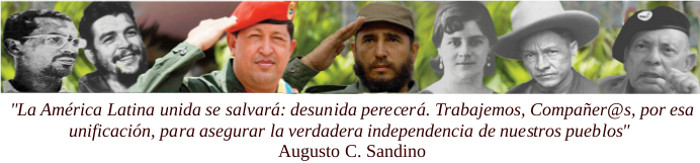
Remarks by President Comandante Daniel
at the Meeting of Central American Presidents
with Presidents of the IDB, CABEI and the World Bank
November 20th 2020
Our greetings to IDB President Mauricio Claver; to Central American Bank President Dante Mossi; to World Bank President David Malpass and to its Vice-President Felipe Jaramillo, who are accompanying us in this Meeting. Likewise, for the authorities representing the sister countries of El Salvador, Costa Rica, Guatemala; for the Prime Minister of Belize who is accompanying us, and for President Juan Orlando Hernández who has been very active in these initiatives, after the visits he made to Guatemala, he visited Nicaragua, and so we were able to engage with the Central American governments, the Central American Presidents, to work out a way ahead. Opening the way ... Yes, clearing the way forward!
And further, our condolences to all the families in the region who have suffered loss of life, and all those that are affected, without housing, going through difficulties.
I want to stress, taking into account that the situation is really complex and difficult, as has been well described by the representatives of the Central American countries . First of all, we must recognize the Central American families and the institutions of the Central American States, civilian institutions, armed institutions, the health sector, the systems of prevention and attention to disasters, the People, who have experienced and are facing these scourges with much courage, with much fortitude, first the coronavirus pandemic and now this one to do with Natural Disasters, and also the capacity that has been achieved developing preventive measures so that the number of deaths is smaller, so that, as Juan Orlando noted, the population responds to the first alerts, leaving places at risk to move to safer places.
I remember Hurricane Joan, in 1988, that entered with great force over Corn Island and hit Bluefields, and a little to the south, with a strength of 250 kilometers. The city of Bluefields was damaged, and there were entire neighborhoods of Bluefields that were destroyed; Corn Island was also destroyed. And then the forests, with trees fallen totally on the ground, and the trees that didn't fall, were totally without branches, branchless.
I remember that when the hurricane was coming, that it was a very slow advance and that suddenly it would veer North, that suddenly it would veer South, it was not known then where it was going to enter, it was difficult to mark the point, and so you had to be evacuating the population from one place to the other. And it was hard for the population to accept evacuation, and that's when we told them: Material loss can be replaced, Life cannot be replaced; therefore, evacuation is crucial.
With hurricane Mitch we had 3,200 deaths here, as a result of a huge landslide that occurred on a hillside; at that time, unfortunately, prevention measures were not taken to evacuate the population, and there were 3,200 deaths there.Now, with both Hurricane Eta and Iota... Iota is the hurricane that has entered with the greatest force in more than 127 years here in Nicaragua, because it crossed the Caribbean Zone with a force of 260 kilometers. But the preventive measures, the organization of the population, the communities, the different Institutions, the Army, the Police, allowed us to evacuate people from the main areas of risk, and practically without a single death due directly to the strength of the Hurricane when it entered with its winds and intense rains, it was later, and of course as a result of the hurricane, that in areas of risk where the population has relocated, there have been landslides. Over these last days we have had the most recent landslides, with a total of 21 people dead, some children, and also adults.
And after all, with our own efforts, with our own resources, we do everything we can and should do, and we have done so across the entire Central American Region. I believe that it is necessary to emphasize how with limited resources the Central American peoples and governments, the Central American peoples and institutions are facing this blow of Nature.
And I recognize and give thanks for all the assistance, the emergency cooperation that has been reaching our countries, including cooperation from the organizations you represent, which have not hesitated to transfer resources; and noting here also, that this conicided with a process we were doing with the Green Climate Fund, which approved and contributed resources to Nicaragua.
I believe the global situation suggests this is not the best time, but there is no other way ahead, given this global situation where the global economy is in crisis as a result of the pandemic; In other words, the most powerful economies in the world are affected, they are in crisis, they are addressing their own problems, but we need them, while addressing their own problems, to also do as they have always done and are doing through these organizations, namely pay attention to these regions of Central America, the Caribbean and other areas of the world that have very fragile conditions, and where, with the effects of Climate Change in our countries that are not generators of toxins, of poisons that affect Nature, we are the ones who suffer the most from the effects of Climate Change.
We are classified in that context as very fragile regions for which special programs must be developed, for which our Governments must be certain, sure, that programs must go, any type of program must be developed on the basis of sustainability, responding to what teh situation demands of us, in terms of the steps we must take, the measures we must take in relation to Climate Change, and of course looking for international accompaniment.
And I want to call attention, as I did in the earlier meeting we had with the Central American Presidents, noting that it is urgent forsteps be taken in the Central American region, taking into account also that this is a transit point for drug trafficking and organized crime producing drugs in the South for the great market of the North.
The more the stability of these countries is affected, the more affected and disorganized their societies become, then more space is open to drug trafficking and organized crime to strengthen their aim of sustaining and deepening a transit corridor to the United States of America where the big market is.
So, it becomes a security problem too, in the first place with regard to security of our Peoples, and also the security of the Nations where the drugs are consumed, where the drugs are sent. And also for the nations where the drugs are produced, because put simply, as long as the demand is there, then there will be consumption and this will affect us all. It affects the producing countries, it affects the Peoples of the producing countries, it affects the Peoples and the youth of the consuming countries, and it affects all the Peoples here in this corridor, where, in addition to the efforts that we make to combat drug trafficking and organized crime, when situations like these occur, then that effort is weakened, because the forces involved in attending to the issue of drug trafficking are more concentrated right now on saving lives, in protecting the population, in moving families, giving them security, across the whole Central American Region. So, the matter becomes a security problem, and I think that's a point we have to incorporate.
I remember that there was an agreement a few years ago by the International Community, back in Guatemala City, where it was agreed to allocate funds for work, for production, because naturally, by strengthening work, education, and health for our Peoples, we manage also to remove the basis for drug trafficking and organized crime, and also to strengthen the institutions that have to deal directly with these criminal activities.
I think the fact that we are gathered here really shows a great sense of responsibility on the part of the presidency of the IDB, on the part of the presidency of the Central American Bank, on the part of the presidency of the World Bank, that is, they are paying attention to our problems. And we hope that we can continue working and articulating a plan of action where the BCIE, as has been well pointed out, is the organization that can most easily coordinate this Plan of Action with the Central American Countries, accompanied by the IDB, accompanied by the World Bank and other Institutions, to then promote it, develop it and seek the necessary resources.
Thank you for giving us the opportunity of this exchange which offers to our Peoples the hope that we will have greater international accompaniment in this heroic battle that the Central American families are fighting.
Faced with these natural disasters, organized crime, drug trafficking, extreme poverty, and drought, we are fighting the battle; and moving forward even with economic growth indicators that are seriously affected, as only the following facts show us, the first calculations indicate that our Gross Domestic Product has been affecting, costing us at least 4%, 3.5% or 4% is the current first estimate.
Of course, we still need more data to be able to have a good estimate and then definitive information about the damage, the economic losses, for example to our hospitals; in our case, we have made an enormous effort to build hospitals across the whole country, and that has helped us to face the pandemic, and we have had hospitals destroyed there on the Caribbean Coast, but we are going to rebuild them, we are already working to rebuild them, and looking for the resources to rebuild them.
So, we have priorities among priorities that of course will have to be established in the plan of action among the countries of Central America with the international organizations. Thank you very much.