Message from President Comandante Daniel to the families of Nicaragua
January 11th 2021
Nicaraguan brothers and sisters, Nicaraguan Youth, today now we are beginning, already we are in the first days, first weeks of the month of January 2021, here in this historic Park, before the Monument to Ruben Dario, just a few weeks away from the Commemorations of the Birth of Ruben in the month of January, on the 18th, and then, of Ruben's Passing to Immortality in the first days of February, we salute all Nicaragua's young people, Nicaragua's Youth, with that magical phrase of Ruben: "Youth, Divine Treasure!"... Youth, Divine Treasure!
Rereading Rubén's Poems, Rubén's Political Writings, his analyses, his reflections, they are still valid now; that is to say, they are valid for our People, for Nicaragua and they are valid for Our America. Because he well expressed in his political writings, in the Chronicles he wrote from Buenos Aires, from Spain, from different places, in which he is constantly pointing to, in his own words, he speaks of Imperialism; he uses that word, Rubén, "Imperialism".
He speaks, with that vision of his, with that wisdom of his, about the United States then... imagine, Ruben writing, analyzing, in the last quarter of a century of the 1800s and the beginning of 1900s, analyzing what is happening in Nicaragua, and what is happening in Latin America, and acknowledging the power of the United States, and explaining how the United States, with so much power, could make a great contribution to the Peoples of Our America.
But Rubén already points to the Monroe Doctrine, and he points out how the United States, which, with the Monroe Doctrine, committed itself to defend Latin American Countries from any extra-regional aggression, instead the Monroe Doctrine became an instrument for the United States to attack our countries, and that when an extra-regional power, England, not by chance the very same England that invaded the Malvinas, occupied the Malvinas and provoked the war in the Malvinas, the very same England, at the very time when that Treaty was already in place, by which, in these new times, the United States was committed to supporting any Latin American country against the aggression of any extra-regional power.
And just as the United States became England's accomplice in the invasion of the Malvinas, against Argentina's People, became informants, allies, facilitators of the aggression against the Argentina's People in the Malvinas, Rubén at that time could point logically to what he was experiencing; he criticized the US, he questioned them, he condemned the United States, because when the English landed here in 1895, they arrived here, in Corinto, the United States simply did nothing, what they did was to seek agreements, agreements with the English, to divide up the region's territories.
Rubén indeed has the virtue, it is true, of being an extraordinary poet, who with his poetry revolutionized the Spanish language, revolutionized literature, poetry, but he also in his poems set out positions criticizing US American Policies, US American aggression, and he knew how to point this out in different circumstances. He targeted Roosevelt with the poem he dedicated to him.
Before that, he had written a poem in which he referred to the power of the United States, the strength of the United States, that no one can doubt, but urging that the United States put all that strength to accompany, to support the countries of Latin America. That was the message that he left behind and one that he had hope for at that moment, even with the criticisms that he made; but then too, Dario pointed out once again in depth the practice of North American policy, unmasking once more in depth what the United States interventionist policy in Our America really was.
Here is a quote from a moment when President Roosevelt was in France, in Paris, giving talks, talking about law, talking about humanity, talking about values; at that moment, what Dario wrote led a brother writer, Federico Henríquez Carvajal, of the Dominican Republic, to write:
"Ruben Dario, the famous poet, who was Nicaragua's Minister in Madrid, was in Paris when Mr. Theodore Roosevelt was a guest of France, as well as most other European nations." All of Europe was entertaining Roosevelt. "And while the indefatigable ex-President received, in official or scientific circles, all sorts of demonstrations of support and sympathy, and while the universality of the newspapers greeted the skillful statesman with not a few hyperbolic phrases in honor of the leader of American Imperialism"
In other words, Europe praising the Empire, the Empire was nothing more than the extension and expansion of Europe in America. Because it was Europeans who invaded the North of Our America, and it was the Europeans, Anglo-Saxons in the first place, who murdered the owners of those lands, our ancestors too, in the United States. And it was the Europeans who decided, for themselves and among themselves, to take over these lands. It didn't cost them a peso, they didn't pay a cent. What they did was kill the Indians who refused to be enslaved, and who fought, and were systematically killed.
The Dominican Brother says, in these conditions "let the voice of the illustrious Nicaraguan be heard, serene and insinuating [...] to say to this very powerful head of the Republican Party of the American Union", this President at the time was a Republican, "that he be just and use his influence to respect of the sovereignty of the State of Nicaragua. It is a civic defense of his country, and with it of all Latin American peoples, while at the same time such a forthright appeal to the great federal nation, in the person of Mr. Roosevelt, in favor of international morality and the august rights of free peoples, of constituted, sovereign and equal States, though for now small and weak. This page, this gesture, honors Dario".
Words of this Dominican writer praising the attitude of Dario, speaking for Nicaragua. So you see Rubén Darío in those times speaking for Nicaragua against Yankee intervention. In these times now, all Nicaraguans should be united, speaking against the Yankee Intervention in Our America, and in Nicaragua; against the military maneuvers that are being carried out now there in territorial waters that legally, by law, those waters have to be delimited according to international law, in accordance with previous resolutions and treaties between Venezuela and Guyana.
And what is the U.S. government doing right now? Deploying its war fleet with the complicity of the Guyanese authorities, in what is a flagrant violation of international law, because those waters cannot be transited by any country, because they are waters currently in the process of defining how and what corresponds to the sister Bolivarian Republic of Venezuela and what corresponds to Guyana. That is what is in the treaties, in the agreements, and they are not respecting the treaties or the agreements.
Or what the United States is doing now, which is naming the sister Republic of Cuba, incorporating the People of Cuba, the Cuban Families, in their list of terrorist States, that promote terrorism, which encourage terrorism. In other words, we see a US Government with a US President who continues to deal blows against international law and order, when he is obliged to respect international law and order, not just law and order in the United States, but also internationally. But this is a President who is well known for having trampled on international law and order.
There in the United States they have their contradictions and we have seen how US American society has become polarized in the United States with the last elections. And we could say, it seems, because of what is happening in the United States, that the US electoral system needs profound reforms. Because what is happening is that, first of all, they still have a system that was established when there were states with a small white population and a large black slave population.
Then came the idea of proportionality and that at election time, it did not matter which party had more votes from all the US American People, instead the votes were decided state by state, by their delegates; that is to say, there is no respect for the principle of citizens' the right to vote.
Let's suppose that here we approve an electoral reform where we say that elections will no longer be decided by the vote of the majority of citizens, but that it will be the vote of the delegates of each of teh country's departments, according to the population that each department of the country has. There is nothing democratic about that, and I am sure that the first ones to jump up and down here against a decision like that would be those mentioned by Dario and whom Sandino called "sell outs", "wimps", "quislings".
These would say: "No, you can't do that!" So then we would tell them, but if we are copying the system of the United States which you say is the perfect system, because you have said that it is the perfect democracy. You have sold the idea of the "perfect democracy", when in reality it is a bipartisan dictatorship decided by economic power, by the power of the big businesses that are in charge of manufacturing artillery, aerial armaments, everything to do with the arms race.
That is to say, this is the power, not to mention the other economic powers that exist there in the United States of America, which are the same ones that at the time, back in those days, Dario also refers to, that brought William Walker here to Nicaragua.
Walker came here, why? Because there were American businesses interested in the transiting the San Juan River, crossing the Lake, to connect from the East Coast of the United States to the West Coast. Because we all know, we have talked about this on other occasions, that there was the breakneck rush of thousands of North American citizens anxious to have either a lot or a little or at least some money and they knew that, in the West, gold had been discovered, and everyone was rushing there, but to travel across the North American territory was dangerous, long and dangerous, because there was still indigenous resistance and there were also many robbers, and the wagon trains were exposed there.
So then, US American businessmen, owners of the Vanderbilt shipping lines, said that here was a natural passage which made it easier, safer and faster to travel from New York to San Francisco, down from New York to the Nicaraguan coast, to Nicaraguan ports, and from there move along that route and then head up to San Francisco and vice versa.
Thousands of Americans passed through here, and because of the disputes between the companies and the disputes between the political parties of the time, which we see reflected here now still, those political parties have not disappeared, they are sellout Parties, they sent for William Walker! And then, of course, what the US Government did was recognize Walker when he was appointed President here in Nicaragua.
And Darío addressed them, although generally, since we were small, since we were children, we are more familiar with Dario's Poems: "Margarita is beautiful, the sea, /and the wind, / brings the subtle essence of orange blossom... Margarita, I'm going to tell you a story:/ There was a king who had..." And so goes Dario's Poem.
Or "The princess is sad... what will the princess have? / The sighs escape from her strawberry lips,/ she has lost her laughter, she has lost her color./ The princess is pale on her golden chair..."
Or The Wolf's Motives: "The wolf of Gubbia, the terrible wolf", who met with hatred among people, envy, rage, such that the wolf ended up getting beaten and his only recourse was to return to the mountains and continue his life. Why? Because he found that the people of the village did not live together as brothers, but treated each other as enemies; and if they treated each other as enemies, imagine how they treated the poor wolf. The wolf got beaten every day, until the wolf got so upset he returned to the mountain and again started killing sheep, killing cattle.
That is the poem, or other poems like: "It is something formidable the old race saw:/ a robust tree trunk on a champion's shoulder of a champion,/ wild and brave, whose strong mace,/ wielded the arm of Hercules, or the arm of Samson. For helmet his hair, his chest for armour,/ could such a warrior, from Arauco in the Region,/ lancer of the forests, a Nimrod, hunting everything...", and here Darío is referring to Caupolicán, the Great Indigenous Warrior.
Or, "How happy and fresh the morning is!" We used to learn that when we were starting the first grades. "How happy and fresh is the early morning / when the air takes me by the nose; / and a fat and lovely girl,/ grinds corn with a stone".
How many poems we learn at school as children, and then when we grow up some of us explore Dario's writings a little more; but making a foray into Dario's political writings is really something impressive.
Here is this book of Dario's Political Writings; there are the other books of the poems, which are extraordinary, unquestionably. But in these political writings one can really see the genius of Darío who did not limit himself to producing the wealth of his literary revolution, but also dedicated himself to the struggles of our People, the struggles of Nicaragua.
You see, this matter became controversial, although it had the support of the majority of the population, but it became controversial a few years ago, now in the time of our government. if you look closely, it deals with the Canal across Nicaragua, and refers to the treaty that the United States imposed on Nicaragua, whereby the country lost all rights, and it refers to the deputies of Nicaragua's Congress who happily approved that treaty.
They are the same ones that in 1990, in the National Assembly, approved but without managing to comply with all the legal formalities, the deputies of the UNO government, at the request of the UNO government, a government imposed by the United States of North America and the first thing it did was to say that Nicaragua its right, awarded under the judgment of the International Court of Justice, to be indemnified with billions of dollars.
In the same way, Darío criticizes the deputies, who are the same, their behavior is the same as those who now want to get control the National Assembly, they are the very same, just there to do everything the Yankee orders them to do.
Darío says here, look... "American Imperialism is not of today," and he is saying this all those years ago, imagine, more than 100 years ago Rubén Darío was saying: "American Imperialism is not of today, American Imperialism about which so much is spoken, is a phenomenon that has occurred and occurs in all nations that are growing larger, and unable to fit, as it were, in their own territory, they need to extend by the natural law of expansion.
American Imperialism is not of today, as some people believe, it has channels and deep roots in the constitution of the history of that great country, when Spain's American colonies became emancipated, the United States gave their help, of course, recognized them as independent nations, and proclaimed, to defend them from Europe, the famous Monroe Doctrine".
In other words, the Yankees appeared then as if they were going to defend the colonies that they were emancipating themselves; but what does it say later: "The American Government said to Europe that it would be annoyed if the European Powers intervened in the affairs of America, either to make the new Republics return to Spanish domination, or to obtain territorial concessions from them".
Note how they are already deciding about all America, it was already a contradiction with the United States becoming an Empire just like the old European Empire; already the European Empire was weakening and the North American Empire was getting stronger.
"The nascent Spanish-American Republics that were just beginning to be formed were very weak and small; the Motherland had left them like Lucretia's child, naked on the Earth, and also bloodied by wars of Independence.
Monroe's Doctrine established a protectorate over them, and the American hegemony corresponded to the United States, which in those days had a population of about 10 million". In other words, the whole region had populations nothing like the populations of our countries now.
"The most brilliant triumph of American Imperialism," take note... "However, when in 1859 the attempt was made to open up an interoceanic canal across Nicaragua, the United States had to recognize England under the Clayton-Bulwer Treaty". That is, there the Empires agrees, above all the Empires of the United States, of England.
"England recognized the United States the right to build the Canal wherever the Washington government wants, and to close it in time of war, according to the treaty". You see, they imposed a treaty, this is the most brilliant triumph of American Imperialism in those times. Look at it, they imposed it on all of America and on the British by its supporting the treaty.
"The English and the Yankees, without being close friends, seem to be understanding each other lately for the domination of the World," as they understand each other now in these times. The Yankees go and attack a country with so-called sanctions, the English follow, and then the Europeans follow as well. Yes, take a good look.
Then again Rubén says here, calling the Knox Note, "an attack against the sovereignty of a People". This is a book that really contains a wealth of what Rubén lived, what he saw, and what he pointed out, and what he discovered, and what he denounced. Because he ached for our Peoples, for Our America, he wanted Central American union and he said so in as many words, here are Dario's writings and poems about the Central American union, and also on Latin American and Caribbean unity.
And we, consistent with our historical roots, and therefore with the Living Thought of our indigenous Ancestors, with the Living Thought of those who defended Nicaragua from the Yankee invaders in San Jacinto, of Dario's Living Thought, of Zeledón's Living Thought, of Sandino's Living Thought, of Carlos. That is to say, if we set out on a route through our history, we are going to find thought that is really alive and is so living and so up to date, that it tells us with absolute clarity to continue fighting, and not to giving up, but to continue fighting. This is what Dario teaches us, all of us.
And seeking, as Dario did, seeking that the United States, as well as Europe, understand that we do not accept being anyone's colony. That they let us get on with our work. That they let us develop our programs, our programs that have to do with the transformation of health, education, recreation, public investment in human development, sports, expanding coverage and quality of water and electricity services, in which we are already approaching 100% coverage of electrical energy; roads, highways, bridges, ports, airports.
Who would have thought that there would ever be an airport in San Juan de Nicaragua? That was a little place lost there, and practically facing the sister Republic of Costa Rica, that is, they are separated by the river. So, if they needed to study, they crossed to Costa Rica, if they needed to buy things, they crossed to Costa Rica, if they needed fuel, they crossed to Costa Rica, if they needed medical attention, they crossed to Costa Rica.
With our Revolution, with the Darian Revolution, because this is a Darian Revolution, the Sandinista Revolution is a Darian Revolution, we were able to incorporate these communities and this symbolic town that was known as San Juan del Norte, we were able to integrate it into Nicaragua, and now there are schools there, there are health posts, there are gas stations, there is food supply so that people can buy right there.
They are even now coming over to buy from the Costa Rican side as well, because they find that it is cheaper to buy in Nicaragua than to buy in Costa Rica. And that's not bad, it's good, the exchanges that take place in the border areas we support them, we promote them, both in the communities that border Honduras, as well as in the communities that border Costa Rica, and also the Caribbean Communities that border the Caribbean Islands.
We continue to strengthen the legalization of properties. We have given thousands of property titles to rural families and other families who lived in their houses, who had small plots of land and had built a house there, but did not have a title deed.
Imagine the insecurity that a family goes through, especially the head of the family who does not have a title deed, and who is threatened with eviction by scoundrels, who use lawyers to find a way to evict them. And in that regard we have managed to help thousands and thousands of Nicaraguan families, without asking them what political party they are from, or who they voted for. They are simply Nicaraguans, they are Nicaraguan sisters and brothers and they have the right to a plot of land, a piece of land for their home, or a plot of land to cultivate, in the case of rural famililes.
Likewise, all the works we have developed on the Caribbean Coast, an area that was abandoned and where we have titled all the communities of the original peoples that live there on the coast: the Miskito communities, the Mayagna communities, the Ramaquíes, the Afro-descendants.
There, we have distributed titles in a territorial extension of more than 35,000 square kilometers. To give an idea, the Salvadoran brothers and sisters with a population a little larger than ours live in a territory of 20,000, 22,000 square kilometers. So the Caribbean Coast is a large territory. But in addition, there on the Coast we have modernized the airports; in Bilwi it goes without saying, and also in Bluefields, and in Corn Island.
And there on the Coast, the miracle of the highway has com about, which after centuries finally unites the Pacific population with the Caribbean population and the Caribbean population with the Pacific population. This road was built with much love and dedication by the workers, a road that was difficult to build because it rains a lot there and you have to take advantage of the times when the rains abate to be able to get to work.
There the Minister, our Minister, General Oscar Mojica, you'll have seen him, he doesn't stay in his office, he goes around supervising the works, the roads, the bridges. At all times, he has not stopped for a single day, even in the most difficult moments of the year 2018, there he was inaugurating highways, roads, and that is where this extraordinary work was built, not of asphalt because asphalt does not resist the rains well, it is easily destroyed, but of concrete. So it's already a solid road.
And on the road to Bilwi, for that whole region of Puerto Cabezas, which has its capital in Bilwi, we are working there to build the bridge. The bridge over the Wawa River is already planned, over what is an immense river that for now must be crossed with a barge, and when it rains a lot the river overflows and even the barge gets displaced, is diverted, and traffic stops.
But in addition, we have already advanced in what were known as the "quagmires", which was a transit point in the Minign Triangle where transport regularly got stuck, especially in the rainy season. And what did we do? That's where we first experimented with concrete. Then, where the roads were quagmire, we didn't try asphalting them because the rain would wash it away, but not concrete, so, concrete; so we managed to overcome that transit point.
And now, new routes that we are also developing to move from the other parts of the Mining Triangle to Bonanza, and from Bonanza to Waspam, to Bilwi; In other words, to cover all of the mining towns, Rosita, Siuna, Bonanza, and then, to move ahead with a route that is going to promote great development in the area, towards the very tip there, heading for Cabo Gracias a Dios, where the great storm occurred with the sail ships in which Columbus came, and that in the midst of that great storm they found relief there because the waters were calm, there was no storm, and that's where the name comes from, Cabo Gracias a Dios.
And there we have Waspam as the most populous point and with the most economic development, and the communities a along the river; that is, joining the Pacific also by that route to the River Coco, to Waspam. And we are also working on the ports. Of course, the port of Bilwi must be rehabilitated and reinforced for the immediate future.
And we are working, we are doing the studies, to have a deep water port in the Bluefields area. With a deep water port in the Bluefields area, and now that we already have the road from Managua to Bluefields, then this port makes sense, because without the road, we would have to bring the cargo by river. With the Highway it is much faster, what we export can go by the highway to Bluefields, and what we import can travel from Bluefields to Managua or to any other city where the cargo may be going.
Then, naturally, we are attending to the damage caused by the two hurricanes, which thank God and we must first recognize the role of the population, pf the communities, then of all the State Institutions that joined forces to accompany the population, to safeguard the population.
All the institutions combined efforts, and there Dr. González of course with SINAPRED coordinating too with the Civil Defense of the Nicaraguan Army, which has a very well organized Civil Defense, part of the Army of Nicaragua and with the Police.
There are two anecdotes there: firstly, that of a group of community brothers and sisters who refused to leave, and they refused to leave, the majority left, evacuated, and these refused to leave; then the Army compañeros decided to stay with them there accompanying them.
The compañeros who came to evacuate them might have said, "well, we'll leave them there and go" But no! They stayed with them there, and advised them how to face the onslaught of the winds, the rising waters; so they accompanied them there and gave them guidance to protect themselves, there were children, there were women, there were men. In the end everyone was saved, and how that community thanked the compañeros of the Army...
Secondly, we cannot forget the image of the Police sisters and brothers where there was a flood, one of those violent floods and there was no other way than to cross except by ropes thrown across and made fast from one side to the other and then to hold on and get across like that. And the image of the Police compañero who made his way with an infant, made his way across the waters, coming across with the child, and the mother following, assisted by another compañero, and how the child passes across to the other side, and the mother so happy, and everyone happy and grateful to the Police.
In other words, these are images that remain engraved in the population, both of those who on the spot and those who saw it on television, where you can see the willingness to sacrifice, to expose Life itself on the part of the sisters and brothers of the Army and the National Police; likewise, of all the civilian personnel who mobilized there; the health brigades, medical brigades; the construction brigades who were immediately there working with the community to find a way to clean up and then begin a process of reconstruction.
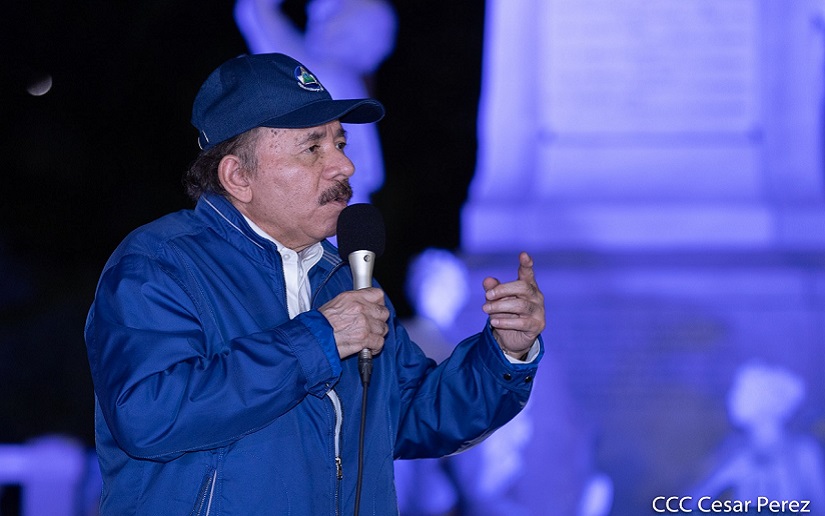
The shipment of thousands and thousands of zinc roofing sheets, there the caravans set out, from here in the Avenida from Bolívar to Chávez, the convoy was formed and they set out, and the convoys are still leaving, now also with prefabricated classrooms, very well made prefabricated mobile classrooms, with colors that have to do with the colors of our Caribbean brothers and sisters.
So then, we recognize the effort of those convoys, driving day and night in that long journey from Managua to Bilwi. There was a moment when you could not pass during the strongest moments of the hurricanes, because the Wawa River had overflowed and you could not get across, but then they managed to pass across and there we are going ahead with the reconstruction. And recognizing the effort of all the Nicaraguans who have taken part.
Likewise, I would like to thank international cooperation, because there has been international cooperation where the Nicaraguan State is respected, the coordination mechanisms with the cooperating country have been established, and it is guaranteed that what arrives, reaches the people it should, that is, the people who have been affected, whether it was food for children, food for adults, or clothing, and now the process of building houses, schools, health posts. All of this is going on, with a lot of energy, with a lot of impetus, in the spirit of our Caribbean brothers and sisters.
I was telling you about the programs of prevention, protection and care for Nicaraguan families, care for people with different abilities, for the elderly, the maternity homes... How many maternity homes have been built and how many maternity homes are still being built! Likewise the units that are being built with the Police to protect families, women who are victims of aggression, or family conflicts that occur between the couple and suddenly the man assaults the woman. That cannot be! That cannot be! That must not be!
Not to mention when crimes are committed, which is why we resorted to the National Assembly, what for? So that here we might have a maximum sentence of life imprisonment, not the death penalty, but life imprisonment. Because it is not possible that when brutal murders are committed against children, or murders where the son murders the father and the mother... That man cannot be free to walk in the street! As a last resort, we will have to put him in jail and keep him there for life, because if he stays on the street he will continue to kill... That person has already lost their senses!
Or those who commit acts of terrorism. For acts of terrorism in Europe or in the United States, even the death penalty is applied there, and if not they receive life imprisonment. Terrorism is the most severely prosecuted offense in the World.
Or hate crimes, that cannot be permitted! Those brutal crimes where they grab a person, torture them, strip them, beat them, make them run or even cover them with fuel and set them on fire, that cannot be repeated in this country! Those are hate crimes.
For a crime like that in a European country or in the United States, perpetrators suffer the full weight of the law; even in the United States, now, with this uproar that has been created with the elections, in the United States they are quoting there in the same US American Press, on US American Television, the article of a law that they have, where the law says that those citizens who demonstrate violently and not peacefully, but violently, against a law passed by the Congress of the United States, go to prison and can get up to 20 years in prison.
And here the pretext was the law, that was the pretext, they rose up themselves against a Law, but what they really rose up againstwas a Project of Reconciliation, of Peace, one which was being consolidated in our country.
Then there's the Love for the Little Ones program; School meals and packages; literacy and education for youth and adults; the Zero Usury program; the Tod@s con Voz program; the Solidarity Roofing program; Houses for the People, Productiion and Food programs, which means distribution of livestock, poultry, high yield seeds, and this helps ensure more food, both for the families working their plot of land and for those that are sowing and increasing their productivity, and for those working in places that have nothing to do with agriculture and who have to buy their food. There must be no shortage of food.
All our priorities in this year 2021 are centered on these programs I have mentioned, and above all, with greater emphasis, as is to be expected, on helping Nicaraguan Families continue the fight against the pandemic. Because the pandemic has not disappeared, here we have managed to control it well, of course we are hurt by and we feel the death of compañer@s, Nicaraguan sisters and brothers who have died as victims of the pandemic.
And then there are the projects that have to do with public investment that I have already mentioned; social spending; production. As regards production we have the Genetic Improvement Program, and this program is already under way, and this has to do with genetics and development of the beef and dairy production, which includes the production of grasses to improve the nutrition and performance of the cattle... there's that cattle program, and also their are swine production programs.
So there is the Genetic Improvement and Development Program for cattle and also one for pig production, that is to say we are concentrating resources, on the one hand, on meat and milk from cattle, and on the other hand, on meat from pigs, .e
Recovery and reactivation of fishing: rehabilitation of infrastructure; cold store chain and equipment for fishing; stockpiles also to supply the market; fishing fleet; fresh water fish laboratories; there in San Carlos, aquaculture production projects; the Fish for Life Plan, and the authorization of funds for reactivating production.
Projects for the production of basic grain seeds, beans, rice, corn, and vegetables, citrus too, addressing these with what we are already have in hand, the Technology Bond, so we'll be promoting it with greater force. In other words, we have already been doing all that we have been talking about here, but now we are going to do so with greater impulse.
Then too, Projects for the elaboration of equipment and tools for production, to add value and transformation; that is, to add value to the products. We already know what that means, that it will allow us to market them right here, but with value added already, and also to export them as well.
Projects to strengthen the capacity to experiment with and transfer agricultural technologies to the Caribbean Coast. Strengthening the Agricultural Health Surveillance System through Medium, Small and Micro businesses in rural and urban areas.
The Healthy Garden Program. The Program for egg production on small poultry farms and for the genetic improvement of birds. All of this involves thousands of families in the countryside and also some people in the peripheral areas of the main cities.
Promoting the creative capacity and innovation of Small and Medium Sized Businesses in Nicaragua's industrial sector.
Then, of course, we have resources for Health Care; also for Climate Change, we have funds for Climate Change; Housing. That is to say, this is all part of a Plan that has been worked on very efficiently by the brothers and sisters in the economic area and particularly by our brother Iván Acosta, Minister of Finance, working tirelessly, round the clock.
The truth is that here we have sisters and brothers working in the different institutions without a fixed working day. They have to be ready at any hour and at any time, if they are called at 3.00am, then at 3.00am there is nothing for it but to go out and attend the need, as one attends a patient, as one attends a traffic accident, as one attends a health emergency, also attending situations that have to do with natural disasters, as has been done here now and we have done with these hurricanes.
We have done this and we continue to do so with, not only facing the Covid virus, but we face a quantity of illness, these are periods where a quantity of illnesses appear seasonally that are similar to the Covid when it begins: strong colds, strong congestion, what we call "the bone breaker", that makes the whole body ache, throat infections, such that it can be thought that it is the Covid illness, because they are similar symptoms, and of course it is necessary to attend them and not to underestimate them .
That is, at the slightest symptom you should immediately seek attention, and the ideal is that the attention, when it is received in good time, means being able to stay at home, so as not to have to stay in hospital, care is given at home, and the medicines are guaranteed, it is guaranteed that doctors are come to check up and see how the illness is evolving.
But it is important to react, not simply to trust and to wait because maybe you still do not have much discomfort, because if complications do arise and then you are short of breath then there the situation gets complicated. That means that the lungs are already invaded, either by the Covid that may have invaded the lungs, or a pneumonia that can be perfectly well caused by a 'flu, a cold that is not taken care of and thus ends up in a pneumonia too, and pneumonias are a very high risk. Therefore, we must continue to follow all the guidelines given by the Ministry of Health, the Health Authorities.
Beloved sisters and brothers, beloved compañeros, on a day like today, January 11th at the Rubén Darío Theater, right by here, Nicaragua joined ALBA, and today we celebrate our 14th anniversary of joining ALBA, and here was our elder brother, Machado Ventura, Secretary of the Cuban Communist Party, there was Evo, and our brother who could not miss it, that brother who poured out so much Love for our Peoples, so much Love for Nicaragua, Eternal Comandante, Hugo Rafael Chávez Frías.
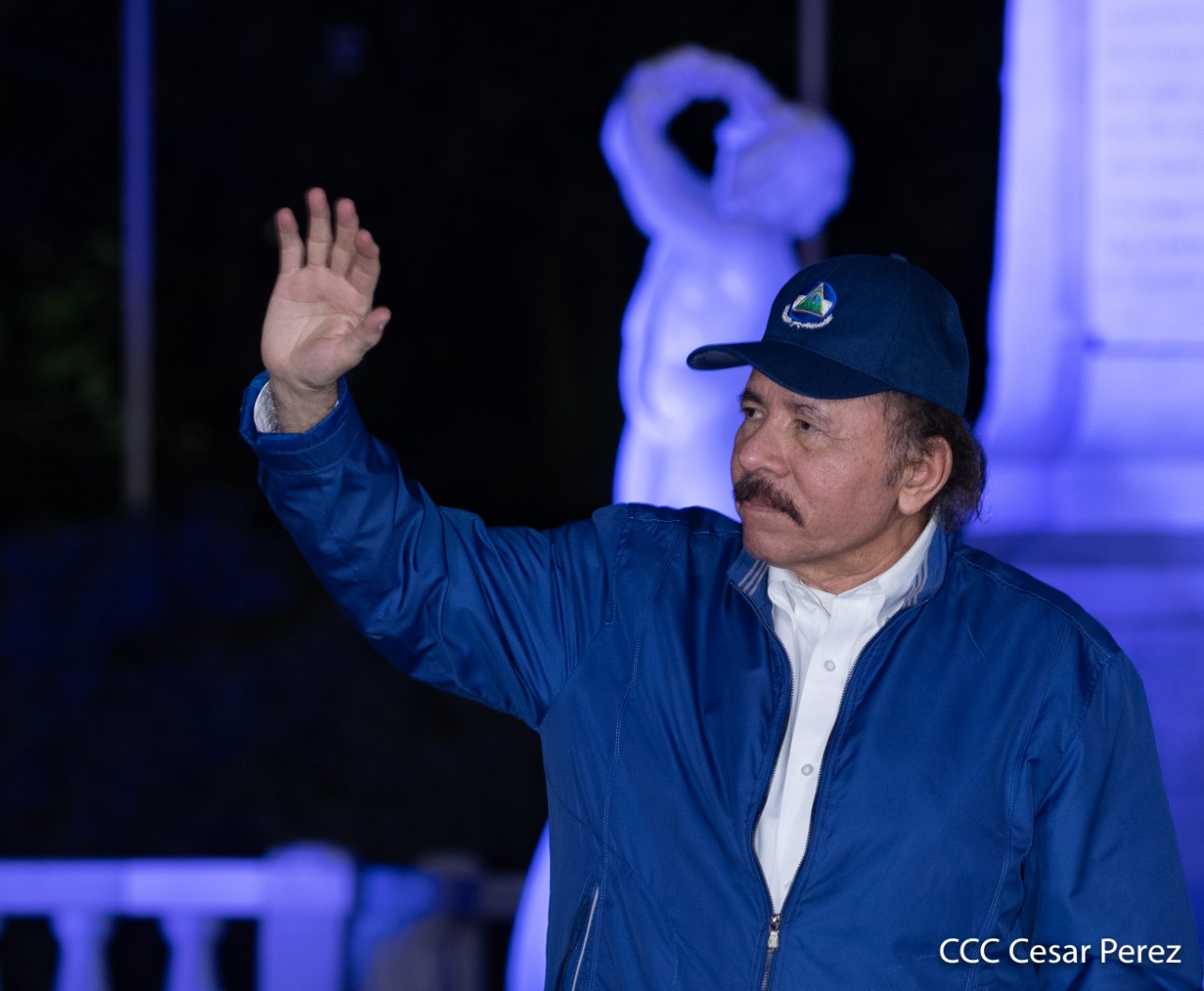
We began that year with the campaign "From Dario to Sandino," with the slogan: Nicaragua, a People that Overcomes! Nicaragua, a People that Overcomes! Nicaragua, a People that wins victories and overcomes with these Songs. Here we have a US American who translated Dario. In the United States there are good people, good people who gave their lives for Nicaragua here in the 1980's, good people like Brian Willson and the War Veterans. Greetings, Brian, who is here in our country, and take care of your health, Brian!
So then, the poem "Ode to Roosevelt" is very popular, very well known in our Country, here it is, here this US American friend took it up. It is a poem of denunciation; but there is this other poem that is also quite well known, which is "The Optimist's Greeting":
Races everywhere, fertile Hispanic blood,
fraternal spirits, luminous souls, greetings!
Because the time will come when new hymns will be sung
tongues of glory
(Nicaragua overcomes!)
A vast rumor fills the air;
magical waves of life are suddenly reborn;
(Nicaragua overcomes!)
Oblivion recedes, death retreats in dismay;
(Nicaragua overcomes!)
a new kingdom is announced,
(Nicaragua overcomes!)
a happy prophetess dreams
and in the Pandora's box where so many misfortunes arose
all of sudden, we find talismanic, pure, laughing,
as Divine Virgil might have written ,
heavenly Hope, the divine queen of light !
(Nicaragua overcomes!)
... while two continents, made fertile with the glorious remains,
of ancient Hercules, calling up that great superb shade
tell the world : high virtue is resurrected
that Hispanic progeny's birthright over centuries.
Abhor the mouth that foretells eternal misfortunes,
(Nicaragua overcomes!)
Abominate those eyes seeing only dismal auguries,
(Nicaragua overcomes!)
abhor the hands that stone illustrious ruins,
(Nicaragua overcomes!)
or that hurl torches or the suicidal dagger.
(Nicaragua overcomes!)
Set down those deaf impulses in the bowels of the world,
the imminence of something fatal today moves the Earth;
strong giants collapse, two-headed eagles fall apart,
and something is starting as a vast social cataclysm
on the face of the earth. Who will say that the dormant sap
does not wake up then in the trunk of the giant oak
under which the Roman wolf's udder was squeezed?
Who will be the fall guy denying vigor to Spanish muscle
for the Spanish soul to be judged inept, blind and disabled?
It is not Babylon or Nineveh buried in oblivion and dust,
nor among mummies and stones does the queen inhabit the tomb,
the generous nation, crowned with unfading pride,
that fixes the anxious looks towards the edge of the dawn,
nor one where Atlantis lies buried behind the sea,
but one with a chorus of tall, robust and strong stems.
Join in, shine, and gather the scattered beams;
form a single beam of ecumenical energy.
Blood of Hispania, fertile, solid, and pure race,
reveal past gifts that were once your triumph.
Return to the old ardour, return to the burning spirit
that will send out tongues of fire in that epiphany .
(Nicaragua overcomes!)
We conclude by committing to our People all our work, all our dedication, all our intelligence, to fulfill all these programs, and other programs that will arise as time goes by. And this is a year of great significance for the Central American People, it is the year of the 200th Anniversary of Central America's Independence.
It has been a long historical journey fighting every day for Independence, you see; I mean, Independence was proclaimed, but proclaiming Independence is not enough, it has to be secured, and we have had to fight and fight and fight during all those years in order for Independence to be a reality.
We had to fight against Walker's expansionism that was coming to crush us Central Americans. We had to fight against U.S. interventions, against U.S. military occupations, against the tyranny imposed by the United States; that is, we have had to keep fighting day by day, to keep fighting.
And that is a Principle of Life. In order for Life to continue, you have to be fighting for Life every day. Likewise, so that Independence can be safeguarded, we have to fight every day for Independence, because the Independence of our Peoples is still under attack, still being threatened by the Imperialists of the Earth, as Sandino called them.
But we have to fill ourselves with that vigor of Rubén in that Song of Life and Hope. Look at the call that Rubén makes to us telling us: Unite! Unite! Yes, let us unite Nicaraguans, let us unite, and we will be stronger to defeat Poverty, we will be stronger to have more employment, more education, more health. We will be stronger to live with dignity and to be able to walk with our heads held high.
This year is a year of the 200th Anniversary of the Independence of Central America, and we will commemorate it with all the Central American Brothers. It is also a year of many Elections in Latin America; here the Supreme Electoral Council has already made known, as is its duty, the first information was made known last year, in relation to the elections the process will be starting, I believe it said, in May.
That is another task that must be attended to, unquestionably. What for? To guarantee the continuity of all these projects that are under way, of all these works that those watching us via this television and radio network, can look right there in their towns to see how many works have been carried out, they can see right there in their towns how many streets, how many houses, not only of the Bismarck Martínez program, but also houses that are being built in the regions, out in the communities, at the initiatives of their mayors. And they can see for themselves, we see it every day, and they see it there in their communities, they can see it all...
How electrical energy is reaching them, where they are living in every community. In other words, what we are talking about, you are living it, you are observing it in your region, in your community, in your neighborhood, and in the entire national territory.
For example, the airport of San Juan de Nicaragua is there, you can see it, and when was it inaugurated? When was it built? It was with our Government.
And the great challenge is, as Dario says, to unite! And we have to unite once again all the Sectors: Young people, Workers, Farmers, Producers, Traders, those in the Tourist Sector, the Entrepreneurs, Teachers, Health Workers, Construction Workers.
We have to unite all Nicaragua's Families, so that in a new chapter, in a new stage of this Revolution, of this Revolution of Reconciliation, of Understanding, and of Peace, we can build under new conditions the Great Alliance, the Great Unity that we managed to build in that first stage until the year 2016, and then that Great Alliance collapsed, because the objective of our enemy was to make Nicaragua collapse, to take possession of Nicaragua.
But the People said No! No! No! After much patience the People said No! And now it is a matter of working so that after this year's Elections, the General Elections, a Great National Agreement, a Great National Dialogue can be installed. What for? So that what was approved in the Constitution can get going again, taking into account new circumstances of course, and here we make a call to the American governments, and in this particular case to the new President of the United States, President Biden, so that the United States can deal with our Region, with Latin America and the Caribbean, with Nicaragua, based on a policy of respect and understanding. As Dario said: If the United States were to turn in that direction, how much benefit and how much respect the United States would gain.
So, beloved brothers and sisters, always with our faith in Christ, with our commitment to our Heroes and Martyrs, in our the steps already taken and that we will continue to take for the People, to the impoverished so that they may escape from poverty, to those of the middle class sector, to all the economic and social sectors, so that they may know that here is a Government that puts into practice the Christian principle: Love your neighbor as yourself! Love your neighbor as yourself, and we will give more Life, more Strength to our Country.
Long live Nicaragua, Blessed and Always Free!
A Free Country, or Death!