Fabrizio Casari *, January 22, 2021
http://www.visionsandinista.net/2021/01/22/el-limbo-de-la-oposicion/
 Nine months before the elections, there does not seem to be any sign of gestation of Nicaragua's opposition. The days pass quickly, with a constant crossfire of contradictory messages exchanged between the opposition's various components, almost always characterized by threats, hardly even veiled, which only complement the most wild hypotheses. All options are on the table, said former President Trump, both the idol and headache of Nicaragua's coup mongers, because he financed them but did not trust them. But there are indeed options, albeit bereft of ideas.
The problems they face are different and none of them should be underestimated. A cultural identity that defines them, sufficient unity to make them viable in terms of the anti-Sandinista voter, the formation of a coalition able to define their role, a program representing their political project, not to mention a guiding management team and an inspiring leader. These elements are as indispensable in a political contest as they are totally absent in the current structure of Nicaragua's political opposition.
Cultural identity. There is none: liberals, conservatives, former anything and everything, ecclesiastical hierarchies and landowners, traitors and mercenaries. It is difficult to find a common ideological ground other than hatred of Sandinismo, of impoverished people and of Nicaragua as an independent nation. And the sum of so much wretchedness adds up to wretchedness, highlighting even more the painful spectacle of internal contradictions.
Unity. It is impossible to unite only "against" something or someone, a "pro" is also needed; but this looks out of the question given the opposition's cultural heterogeneity and appetite for money, their only truly common trait. US efforts to force them to unite are not enough. Perhaps the threat of cutting off funds might suffice, if it were not counterproductive for the US to lose its fifth column in Nicaragua. Therefore, the game is to try to manage them without risking losing them. A delicate operation and one of doubtful success.
A coalition able to play its role. For the moment, the only coalition is one of "all against all". The opposition is mortgaged twice over: first to the Chamorro family, which hopes to dominate the political scene so as once more to hijack the country's resources, and secondly to the traitors of the MRS, who are the opposition's military arm leading the failed coup attempt of 2018, and who claim political leadership for themselves, although no one else recognizes it. So rather than thinking in terms of a coalition we must speak of credentials; in particular accreditation by the US and the EU. Because that is where the money comes from, which is after all the opposition's final destination.
As for a viable political project, here lies the biggest problem, given the extreme difficulty of presenting an alternative program to that of Sandinismo. For the time being, the vivid memory of 16 years of privatizations and the firesale of public assets prevents the opposition from presenting themselves as standard bearers of the national interest, since the oligarch families who hijacked public revenues for 16 years are the very same people now running for election, all ready with knives and forks for the dinner table.
But then too, how can they convince voters they have a better project than the Sandinista one for improving welfare and reducing poverty? Given that Comandante Ortega's government allocates more than half the country's budget to welfare programs, what have they to offer? Abolishing the social policies of Sandinismo? Ending the "Roof Repair Plan" or "Zero Usury"? Stopping financing and support to family businesses? Ending free school lunches or even free education and health care? Hiking prices on the cheapest public transportation in Central America? Or are they going to propose a moratorium on new roads, new schools, new hospitals and all the housing currently being built? Or that energy be re-privatized? Or for the two annual minimum wage increases to be cancelled? How about raising the retirement pension age to 70 and made conditional on 40 years of contributions? Or maybe stopping the country's modernization? The challenge is pretty daunting, isn't it?
All of that would be their true agenda but they can't say so without becoming politically extinct. So what will they announce to the voters? It is not a straightforward problem. Will they say that Sandinismo is in conflict with the different actors of the Nicaraguan society? They cannot, because, as everyone knows, from January 2007 until April 2018, the model was based precisely on the collaboration between the government and the country's various social forces; a permanent dialogue that ended when the opposition forces turned to outright subversion. What changed the panorama was the failed coup attempt orchestrated by bishops, oligarchs and assorted traitors .
As for leadership, the opposition has a fine array of self-appointed political leaders who, by and large, could hardly run a bath. The main fact upsetting their fantasies is the requirement of legal personality, which is what by law uniquely enables political parties the legal name and the real possibility of running for public office. However, without a coalition there can be no coalition leadership since it's difficult to lead something that does not exist. Therefore, the leaders of the different parties and self-appointed groups remain in limbo; they are the least credible figures of the entire national political scene, serial collectors of bad public relations, specialists in empty threats, picking and choosing figments of their imagination.
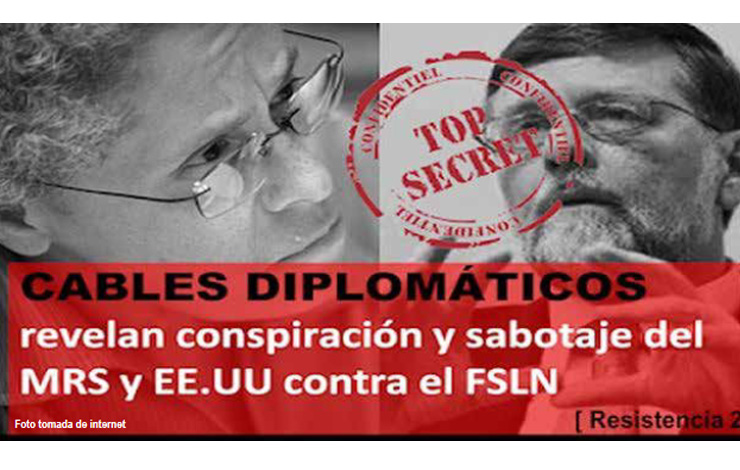
On the subject of self-appointed leaders, the latest news is that the MRS has changed its name (as we had already predicted months ago), because they risked losing funding. So now they will be called Unamos so as not to risk losing US money unlikely be directed to a group with the adjective Sandinista in its acronym, and even the logo with Sandino's hat. One supposes that logo will be replaced by their SWIFT details.
Traitors to the FSLN and practically untouchables for the opposition, they rank as the most despised party in the country. The Democratic Union for Renwal is a kind of alias, an acronym meaning nothing beyond its marketing rationale. In any case, it is also a presumptuous acronym, since they unite no one, are not democratic, since they represent the oligarchic interests of the families that lead them (the Cuadras, Chamorros, Bellis, Cardenals, etc.) and nor do they offer anything new, since they continue kneeling to the USA, towards whom they have dropped the insults of yesteryear in exchange for considerable amounts of money. Money, only money motivates them. If Judas had not pocketed 30 pieces of silver for betrayal, would anyone remember him among the other apostles?
A very bad reputation
In Nicaragua the opposition is barely getting started in terms of political prospects, but already has a very bad image. This is not some preconceived attitude of critics of neoliberalism, but rather one based on convictions formed over many decades, which have seen the Nicaraguan right wing first in love with Somoza, then supporters of the counterrevolution, then protagonists of the great looting of the nation that lasted sixteen years and, finally, as organizers of the coup attempt.
To put the history of the Nicaraguan right wing in context, it must be said that it has always been subordinated to empire. Never in history has it shone with its own light, neither in terms of generating political theories, nor cultural identities, nor models of social organization. It has always been vulgar, ignorant, lacking in greatness and wedded to horror.
It is part of the Latin American right wing that keeps the different Latin American countries sunk in a structural dependence on the United States. Dependence on the Washington Consensus offers the guarantee of stability for a model of quasi-feudal regimes based on oligarchies giving rise to a general bipolarity between the ruling class and the dominated population, a model of society divided between feudal lords and commoners.
As for the irresistible impulse to treachery, it is not only characteristic of a cowardly caste. Their ideological scenario argues that finite territory and resources can only be managed successfully under the tutelage of Uncle Sam. That is to say, not in an expansion of South-South exchange but in the surrender of one's resources to the North. Which, yes, perhaps the North loots all that it can, but that frees the local oligarchs from any concern for the organization of the political and socio-economic model that allows them to do well. In fact, the United States will take care of everything, be the owners of everything, above all of those who see themselves entitled to be their country's rulers.
In Nicaragua's case, the new US administration will now pick up where Trump left off, that is, working hard in the hope of seeing the opposition unite. However, in the meantime, as the opposition wait to see how good their credit is with the new Biden administration, the race for foreign funding has become a steeplechase now that the recently passed laws by the Nicaraguan Parliament represent for the opposition an objective and delicate problem they have to address.
Some people argue that intensifying control over the illicit movement of capital is a possibility, certainly, but it would be really inconvenient for whoever decided to try it out; the new laws in defense of national sovereignty are in fact associated with broader and more effective forms of surveillance. Given the balance of power in the country, no one doubts the outcome of any confrontation that chooses force of arms. Sandinismo is a bitter and indigestible pill for the right wing. It knows how to keep the whole country free from coups d'état, how to guarantee peace and internal stability and thus how to allow the democratic process to express itself. Things won't go well for those who try to prevent or sabotage it and in Nicaragua amnesty is a once off concession that has already been made.
The victory of Sandinismo seems as inevitable as the turn of the seasons: any uncertainty is only about percentages, although an absolute majority is certain. The destiny is already sealed for an election that will be measured in a climate of political tension decided by foreign interference. The vote will take place, in fact, with Sandinismo on one side, representing the good government of these 14 years against neoliberalism, the rotten legacy of the previous sixteen years of misery. Not only will two programs and two different identities be measured against each other, but the elections also seem to be a historical verification between two opposing options: one born and raised under the banner of independence and national sovereignty now become modernization and development; the other whose CV lists only poverty, tears, bloodshed and betrayal.
The FSLN will win because it already has in its guerrilla history the seed of the construction of the new Nicaragua. The opposition will lose because it does not have the majority of the population, because its caste interests prevail over the national interest, because its past is nothing to be proud of, its destiny is distinct from the destiny of the country. Precisely for that reason, having a drama queen past and an unworthy present, it will not be handed any future.
(*) Journalist, Political Analyst, Director of the Italian news outlet www.altrenotizie.org and collaborator of Visión Sandinista magazine.