Fabrizio Casari, Altrenotizie, June 13th 2021
https://www.altrenotizie.org/in-evidenza/9309-nicaragua-la-colonna-infa…
The judicial indictments against some of the leaders of the 2018 coup attempt have put the whole crew of US and European leaders on alert and their international media and political campaign is now under way. The media are doing their dirty work in support of Empire with Italians in the forefront. It is a contrived campaign, because the indictments are a due application of the laws of the State and there is no reason to consider them an abuse.
The investigation aims at dismantling the political-military structure of the 2018 coup. The objective is not to restrict the electoral candidacies of the opposition, as is clear given that not only potential candidates are being pursued, but all those with a specific role in any possible rerun of the 2018 coup. The objective is to eradicate any latent remains of the coup, to preempt any plan of action around the elections, and to do so by applying the law. Right-wing coup plotters are not investigated for the ideas they may profess but for the crimes they actually commit. They risk conviction not for their political opinions, but for breaking the law.
The legislative basis is Law 1055, which applies to anyone who, betraying their nation and against the country's interests, promotes subversion from abroad, calling for military intervention, sanctions and boycotts against the country. Law 1055 is based on a law from February 1995, signed by Violeta Chamorro, which was also passed and defended by some of those who suffer its provisions today. That Chamorro the mother enacted a law that 25 years later affects Chamorro the daughter is a fierce example of vindictive karma.
Some claim this is an attack on electoral candidacies, but President Ortega gains nothing by altering the electoral panorama. All the opinion polls demonstrate that even if the right wing were to unite they would not get more than 26% of the votes, while the President's approval rating is close to 68% and the so-called "hard vote" of the FSLN stands at 46.7% of the electorate. The May 2021 survey of M&R Consultores gives 58.3% support to the Government and 22.7% to the opposition. To think that Comandante Ortega could lose is to reckon that in a few months there could be a global, one way shift in 45% of the votes, that is, about one out of every two voters. The right may have their dreams, but may well wake up on the floor, having fallen out of bed.
It is in the application or non-application of the law where the conflict is played out between the Rule of Law and its rejection. The coup-mongering right wing rejects all legislative action so as to delegitimize the sovereignty of the Nicaraguan State. Not recognizing the government, the legislature and the laws it issues, is the basis and meaning of the coup strategy. The coup promoters think denying the country's institutionality derived from the popular vote, and trying to overthrow it with a coup d'état, is justifiable before world opinion. Thus begins a new coup adventure.
Pavlov's reflex
As it has done every couple of months, the United States has imposed new sanctions. This time on Camila Ortega, guilty of being Daniel's daughter and an excellent fashion designer; on Edwin Castro, efficient leader of the FSLN bloc in the legislature; on the president of the Central Bank, Ovidio Reyes, and on Julio Modesto Rodríguez Balladares, a member of the army high command. Their only crime is being Sandinistas. The new sanctions are proof of impotence, a Pavlovian reflex. Washington wants to console the empire's local hired help, who are fearful of having to pay what they owe. But that is the inevitable destiny for candidates aspiring to everything while in fact being nobodies, who think they can pick and choose the laws and rules at their convenience.
Forced to ensure respect
Updating national legislation to defend the integrity of the country was a necessary response to the destabilization plans prepared by the United States and the right wing coup promoters, namely the oligarchy and the Catholic hierarchy. But, even faced with laws regulating rights and duties, setting limits and establishing spheres of political action, as mandated by the Constitution, the right wing has not renounced another coup attempt as a political option.
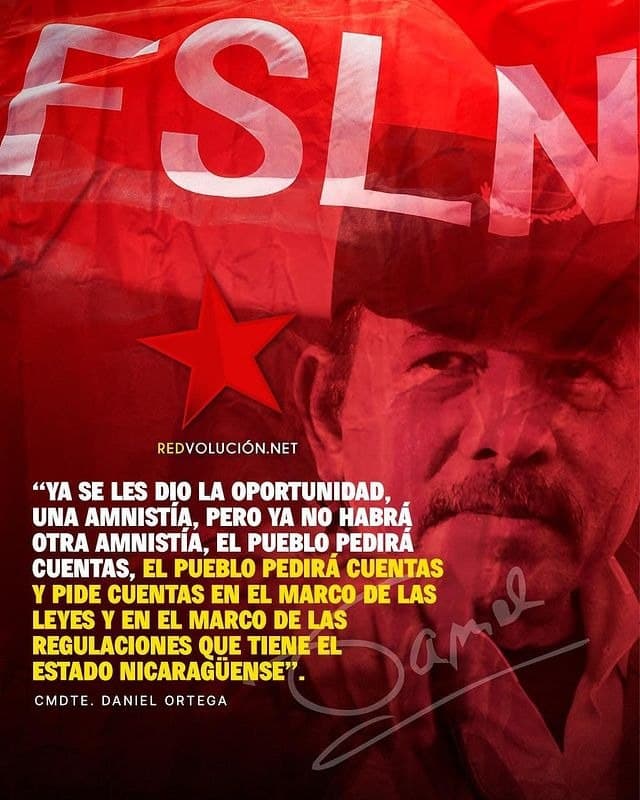
They had the chance to re-enter legal political culture with the amnesty measure of 2019, which, however, laid down the condition of non-repetition of the crime of promoting subversion. Instead, the right wing chose to continue preparing for a possible coup: they continued traveling regularly to the US and the EU demanding punitive laws against their country, even indicating the names and entities against whom to direct sanctions, mounting infamous campaigns against the government, depicting false apocalyptic scenes out of horror movies, like the invention of thousands of deaths from Covid 19 that never happened, all with the aim of triggering measures of international isolation.
But that is only a part of the coup d'état project. Running in parallel is the military aspect. Over recent months the flow of money from the US and Europe has continued, although the Chamorro foundations have declared they shut down their non profit activities. In recent years, more than $7 million from USAID has flowed to Chamorro, of which there is no trace. The money has not been traced or used for any purpose, thus violating the law relating to non profits and disregarding the regulatory authorities. Anywhere in the world, this would lead to immediate imprisonment and judicial seizure of the assets: so why the silence on that issue? Easy. Because it is better left unsaid what no one wants to say.
Namely, that very possibly part of the money has remained in the pockets of the Chamorro family, notoriously voracious in its appetites; but also that a good part has gone to finance clandestine operations twhich a sector of the opposition already has in place. That is to say financing for accumulating the means and resources for a new coup attempt to be unleashed after the elections, as Arturo Cruz can be heard saying on the phone with one of his cronies and as Felix Maradiaga has also already announced. This is USAID's RAIN plan, which contemplates an ideological roadmap guaranteeing US interests in Nicaragua.
The attacks on Nicaragua have nothing to do with supposed legislative abuses; they are political attacks, aimed at achieving one objective: removing Sandinismo from government and replacing it with the right wing in charge. As happened in Honduras and Bolivia, as was attempted in Venezuela, so in Nicaragua. To oust those who have electoral support and install by force those who do not. This is the deep meaning of the coup.
Who is holding whom accountable?
European and US outrage over the investigations in Nicaragua is all contrived. As regards Nicaraguan national security legislation, it is truly paradoxical to hear criticism from the country of the Patriot Act. If they have anything to say about detentions in Nicaragua, let them first look at Guantanamo, the destination of people suspected of the kinds of crimes being investigated in Nicaragua. If Cruz, Maradiaga and company had been charged with the same crimes on U.S. soil, in fact, no one would know where they are today and no lawyer would know how or against what charges to defend them. And even Europe had better keep quiet, given the legal ravages caused in Italy, for example, by emergency anti-terrorism legislation.
Does Nicaraguan law unduly restrict candidacies? In the United States, for treason in collusion with foreign subjects, in addition to stripping of civil rights, the law provides for 15 years of imprisonment. And also "highly civilized" Europe has harsh provisions to protect the national interest. In Italy, for example, Article 9 of Presidential Decree 361/1957 specifies that "cases of ineligibility refer to all those who have relations with foreign governments (e.g. diplomatic personnel of any order and grade) and to all those who, despite having Italian citizenship, are employed by foreign governments". Is there a more concrete example of employment by foreign governments than receiving millions of dollars from them? And why is the Italian law supported while the Nicaraguan law is criticized?
U.S. and European concern for the fate of journalists does not apply to Julian Assange, who was first forced into exile and then jailed for documenting the truth about U.S.massacres in Iraq and Afghanistan; nor do we recall that the EU has called the UK and the US to account for his fate, nor that any European newspaper has called for his release. Nor do we recall that MEPs sanctioned Saudi Arabia for the murder and dismemberment of opposition journalist Kashoggi. And where are the sanctions on Ukraine for the murder in Donbass of Italian photojournalist Andrea Rocchelli? And those on Israel for the murder of Italian journalist Raffaele Ciriello? And on Egypt for researcher Giulio Regeni? Obsequious silence, business as usual. Different weights but only one measure: hypocrisy.
Are the Spaniards concerned about the safety of the Nicaraguan coup plotters? Surely the one in bad shape, with no immunity, is Carles Puigdemont, until last year Governor of Catalonia. He was forced into exile for legally fighting for his region's independence from the Spanish monarchy. The European Parliament sanctioning Nicaragua is the same one that on March 9, 2021 stripped Puigdemont, Toni Coman, Minister of Health, and Clara Ponsat, Minister of Education, of their parliamentary immunity, thus exposing them to the revenge of the most corrupt monarchy in the world.
So, if the EU or the European Parliament want to defend those suffering for their political opinions, let them point the finger at Spain, the European country most active in supporting Latin American fascism. Or, still staying in Europe, you can go and check out all the many the victims of criminal repression by the French police against the Yellow Vests.
If, on the contrary, they prefer going to Latin America out of concern over arrests, they should ask for an account of the unjust conviction of Jorge Glas, former vice-president of Ecuador, buried by a judicial plot organized by Lenin Moreno, the Andean Judas. If they want to talk about State terror, let them consider Chile or Colombia and its murderous narco-government. And let them not forget they received in Strasbourg, with full honors, Salvatore Mancuso, the head of the criminal Colombian AUC. Just to show how much Brussels really cares about human rights.
Mounting coups - diseased and senile malinchismo
First of all, mounting a coup is destabilization. It rejects the rules of the democratic game and expresses itself as quisling-style malinchismo, which in Europe is called "collaborationism": that is, taking the side of the enemy, taking sides against the interests of the nation during a conflict of interests between the latter and countries with opposing interests. Because to define a country as an "enemy" does not require a formal declaration of war: repeated political hostility, adverse international positioning, the exercise of coercive measures, lack of respect and acknowledgment of its institutional processes and sabotaging trade- these alone paint an aggressive picture, a threat to national security and define an adverse relationship with a hostile country. To ally oneself with it against one's own country, anywhere in the world, is called treason and just because it gets supported by a media circus does not turn it into freedom of expression. It is and remains treason.
The Mexican president defined a coup d'état as a process not necessarily armed, that is to say, not one exclusively engaged in by the military or the army. For López Obrador, coup mongering is also the preparation of a coup d'état by means of a climate of destabilization created with the support of foreign governments, foreign media and other organizations.
In Nicaragua, besides being the fifth column of the enemy, the right-wing coup plotters are themselves the enemy. They thought they could ignore the public role of the competent State entities, convinced that they would never react out of fear of producing a political crisis so close to the elections. This is a mistaken calculation, because it does not grasp the absolute centrality that institutionality and legality have in the Sandinista government project. It is a revolutionary project precisely because it has not limited itself to administering better than in the past, but has completely abandoned the idea of a State held hostage by oligarch families and with a merely decorative legal and constitutional order. The Constitution of the Republic rules in Nicaragua.
The right wing is also wrong in terms of political tactics. Because, given the sanctions, the international threats and the non-recognition of the elections, a dialogue between Nicaragua and the United States makes little sense but is in fact the only thing that might possibly have eased the climate in a positive sense for Nicaragua's right wing.
What is the way out?
From the Nica Act to the Renacer Act, currently under discussion in Congress, the United States has taken up its old vice: trying to subjugate Nicaragua by means of ideological hatred and draconian measures illegitimate under international law. The United States does even consider a different tack, a different history and trajectory, one not necessarily hostile, one based on relations of mutual respect. So why should Nicaragua yield now, when throughout its history it has rejected US meddling in its destiny, including by force of arms?
The message is clear: if you think that Managua will suffer aggression without reacting, you are wrong. Washington believes it can subdue Nicaragua, but it did not succeed in doing so when conditions for Nicaragua were infinitely worse, such that success is even less likely now when the context is more favorable, for various reasons, both internal and international, as well as regional and global.
Given the crisis, a solution must be found. A political solution, because the decision to organize a new coup is political and because its instigators are politically motivated. Therefore, if a way out of the crisis is to be sought, it has to be between Nicaragua and the United States. It makes no sense to ask for a national dialogue: nobody talks to the clowns if the circus owner is on hand. Thus, if the United States is concerned about its interests and protecting its local agents, it needs to stop promoting terrorism and permanent destabilization and accept a relationship based on mutual respect.
Ortega has spent his life overcoming conflict to achieve peace, proving himself an expert at both. It is up to Biden to decide the fate of his Nicaraguan hired help. That of the Nicaraguan people is being decided by Sandinismo, led by its Comandante, President Daniel Ortega.