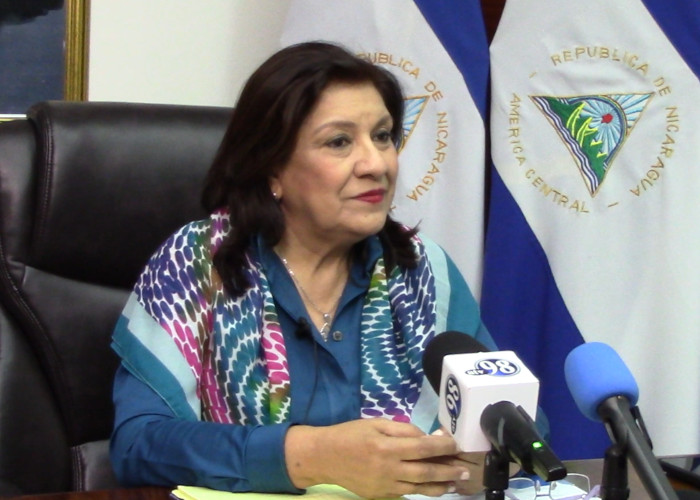
President of the Commission for Women, Youth, Children and Family Affairs of the National Assembly of Nicaragua,
by Camila Escalante of Kawsachun News and Fiorella Isabel of the Convo Couch
January 12th 2022
What does the Sandinista Revolution offer women under the presidency of Comandante Daniel Oretga?
Well, the restitution of Nicaraguan women's rights has been a historical commitment of the Sandinista National Liberation Front. That is to say that not only now is the Sandinista Front concerned about women's rights, rather it has been a commitment ever since the Sandinista Front was founded. And today we are proud to share with you our progress whereby, thanks to the political will of our government, those rights are becoming a reality.
Today gender practice in Nicaragua are reflected at the highest level, namely in the Political Constitution, our gender practices are constitutionalized and have been put into practice. We work from a model of equity, a model of complementarity, of equality, of justice. And from our government's vocation of peace and humanism, we have been working for the empowerment and leadership of Nicaraguan women in all areas of life, in the political, economic, social, cultural, community and family spheres.
Today women in Nicaragua celebrate the fact that we are subjects of economic development. Today, we women contribute actively to the country's economy. We are participants in the great economic, social and political transformations our country is undergoing. And in this sense we feel very proud to have a committed government, a government that has taken on this commitment with great responsibility. Because today Nicaraguan women have access to all rights, rights we did not have before.
Today women have access to health care, which is one of the most sensitive issues. Today Nicaragua has reduced maternal mortality, maternal and infant mortality via our community and family health model. Today we have maternal shelters in all the country's municipalities where the mother and their newborn are cared for,so as to take care of their life and see that they have a humanized childbirth with medical specialists. Today we have access to education, women have access to all the educational modalities they were previously denied. And approximately 60% of women are participating in the different levels of education. There is greater access, more opportunity for women in Nicaragua to study.
Access to housing, we have access to land. Land titles in this revolutionary government are given to women, who are heads of families too, and we also have access to credit so that women can develop economically. And we have access to the means of production, such that today women are empowered and we are included in this employment model and in the social, cooperative, associative economic model, working to contribute to the gross domestic product of this country and to the fight against poverty that we have in Nicaragua.
Today we women have dignity. We have rescued our dignity. We women are respected in this country and proof of this is that we are in fifth place in the recent study made by the World Economic Forum. It examined several countries and found that Nicaragua, a small country in Central America, in Latin America, occupies fifth place in gender equity, which means that today women have access to health, education, the economy and political participation, closing the gap of inequality and poverty.
From the point of view of the United States, they promote this idea that they are the most advanced in feminism, in what they call feminism, however, women there do not earn the same as men. The feminism that the Unitd States promotes sometimes is very symbolic, how is it possible, as you say, that a Central American country, a supposedly third world country, has been able to do better than a great power like the United States and other countries in North America that do not have the economic equality that Nicaragua has under the government of Comandante Daniel Ortega?
This has to do with political will and here in Nicaragua we have the political will of our president and our vice president, that real commitment to equal rights for men and women. And we also have a model, this model of equity, the model of complementarity that has been made possible with the Revolution. That is why Nicaragua surprises people, because we are not only in the fifth place as examined by the World Economic Forum, but also the ILO places Nicaraguan women in the first place in the world, first place in the world, where there is the highest participation of women as ministers, so here we have Education, the minister is a woman, Health, the ministers are women, in the Economy the minister is a woman, in Justice there's a woman, and for Labor there's a woman.
In other words, we are the first country in the world to have the recognition of having the highest participation of women in these responsibilities, but not only in office, but also in the National Assembly, in this parliament, we have the recognition of being in the fourth place in the region with the highest number of women parliamentarians. Recently, those of us who have been elected, out of ninety-one male and female deputies, we have forty-six women and forty-five men. That is to say that we are in the fifty and a little more percent of participation of women. And then we occupy the presidency of commissions, vice presidency, in the junta directiva 57% of the seven members of the junta directiva have been elected, four are women and three are men.
So we have a strong participation of women. You are making decisions, elaborating laws, policies, programs, evaluating, approving and working on economic laws, political laws, social laws, laws of all kinds. So this has to do with political will and it has to do with the fact that we are here. Here a revolution has been made where Nicaraguan women have had great participation in the triumph of this revolution and then in the first stage of the revolution and then when we returned to government in 2007 we are, truly, with that great participation because it is not possible to advance in the fight against poverty if women are not present.
Women have to be present for the great transformations and we have to be present too, that is why we talk about the complementarity model, here we talk about complementarity. Men and women on planet Earth, working and making the great transformations that we have in this country. So here we women have won these spaces with bravery, with courage, with quality, with capacity. We are truly empowered women, women who recognize our rights and see that our rights are respected. So this is the great surprise for people to see that here in Nicaragua there is that political will and awareness because if we talk about democracy you cannot talk about democracy if women are not present.
So, what are we talking about?... Really, in Nicaragua we are talking about a true democracy and we are demonstrating it because not only do we have the participation of women, when we talk about democracy we are also talking about access to health, access to education, access to housing, access to land, access to the means of production, so here we are talking about a true democracy and a revolutionary model and those are the big differences.
And how long have you been a congresswoman?
I have four terms as a congresswoman, yes.
And what are the... you say that women here in Nicaragua now have access to credit which is very important for women's economic rights. What are the laws, the most important legislation for women's economic rights, and what are some of the things that you want to see in this period?
Well, in Nicaragua we have a good legal framework. First of all the political constitution establishes the equality of men and women, non-discrimination against women. And then there is a large number of laws for the protection of women's rights. An important law that we have in our country is the Law of Equal Rights and Opportunities, which establishes 50% for women and 50% participation for men. And this has been put into practice in all national, regional and municipal elections.
That is why today women hold in posts in the judiciary, more than 50% are women, 57% or 58%. Similarly in the executive there is also a high participation of more than 56% of women in the legislative branch. Everywhere we have a high participation because the laws are put into practice, that is to say, they are not laws that are merely written, but laws that have actually been put into practice. And this has also led us to reform the Law of Municipalities so that there is a greater participation of women as mayors, vice mayors and vice mayors, and also of councilmen and councilwomen in local governments.
And we have also reformed the Electoral Law so that there is also greater participation of all women in all political spaces. Then we also have a very important law, the Integral Law Against Violence Against Women. This law, our model against violence is a model of prevention. This law prevents, attends to and punishes everything that has to do with the issue of violence, that is to say, it is a comprehensive law that not only punishes but also trains, educates, trains and establishes values.
We have very important laws like the Family Code. Our Family Code has many provisions for Nicaraguan women, for girls and boys and also for the elderly. In other words, we also have international instruments that we have ratified, such as the Belem do Para Convention and the Convention on non-discrimination against women and non-violence. And besides that we are... the legal system has been strengthened because now a law has been passed to punish all those hate crimes, atrocious crimes, crimes that really harm the dignity of women and on the other hand our government also works from the model of caring for the life of women in all its form by promoting values.
That is to say, via education, via prevention, via family counseling in the neighborhoods and communities, via counseling in the educational communities where we work with all the students, with all the educators in the schools. In order to promote values, we have women's police units that help women get more access to justice, and we are also implementing campaigns to protect women's lives, as well as ensuring they are subjects in the area of education. In other words, in addition to the normative framework, we also work from the model on everything that has to do with promoting values. So we have a very strong legal framework and we think we must continue working on the care of women's lives and women's rights.
The legislation is quite broad and is being put into practice. This legislation is translated into projects, policies and programs that are transforming the lives of us women so that there is more well-being and above all peace and tranquility. Because we women are peace lovers and we women have built and contributed to peace in this country. And that is why we demand peace, we want peace, we want stability, we want to work so as to be able to live well, to live in peace and for there to be a society where we can work harmoniously.
I have a question about how the government is going to support women, as it has been doing until now, according to the family, because when you are a woman sometimes you have children and if women are working and have a career, what methods or what tools does the government have to help single mothers, to help low income mothers, and how does the family structure relate to this new stage, in this century of modern women, who occupy many positions, and so on...?
Well, everything that our government works on is based on this model, on the model of the family and the community. For our government the most important thing are the families and the government proceeds in all its work from that model, from the model of the family and the community, so here we have centers to educate children, from early childhood, where the children can go to school, they get their school lunch. In other words, the mother is not worried about feeding her children because the school provides the children with a school lunch.
This government delivers one million two hundred thousand meals daily to all schools, whether in the countryside or in the city, so children get better food security. Then, they also receive health care because the whole issue of vaccination and attention to children is also linked to health care in schools. But we also have child development centers, the CDIs, where women can leave their children and there they are cared for, they are looked after, they are educated, and women can work with peace of mind because the care and upbringing of children in these centers is done very responsibly. The model comprises all the issues of food, health and education. Because education here is totally free, children are get shoes, they are given notebooks, they get backpacks, they are given pencils, crayons, they get a backpack with all the supplies they need for their development to perform their school work.
So the model that we have in this country is an integral model of attention to children and it is worth mentioning that Nicaragua has worldwide recognition as the country that takes the best care of children. So we have real recognition from the FAO of being the country in the world that takes the best care of children and that is why we have also been reducing infant death and that is why we also see that our children are growing with good health because we are also promoting healty food habits. In the schools they are not going to drink Coca Cola, but rather the children are going to consume what may be available in the school gardens or what is also provided along with their school meal.
So there is great recognition speaking of us as a country, as a government and that demonstrate how life in Nicaragua has been changing and how this government is working to lift our country out of poverty. And we also see that gender practices and gender equity is an axis of human development. Such that our government recognizes this gender equity as an axis of human development, therefore women's rights as well as being rights in themselves, are also the axes of our country's development that translate into access to all rights. So we feel very proud to live in this country and to have a president like Comandante Daniel and Compañera Rosario who do not miss any opportunity to restore the rights of Nicaraguan women.
How do you respond to criticisms from the OAS and the United States that there is a humanitarian crisis in Nicaragua and a human rights crisis?
We have shown ourselves, truly, to be a country that has made great advances. We have made great progress and received great recognition that we are a country that has been reducing poverty and extreme poverty, from 48% to 24%, we are the country that has the best roads in Central America and the region. We are the safest country in Central America and also among some Latin American countries. We are the country that occupies first place in the world with more women participating, transforming and deciding.We are the country that is widely recognized for taking better care of Nicaraguan children.
We are the country that has... we have over of 99% of electricity coverage. We are the country that has greatly surprised people in the successful way our government has managed the Covid issue and the country's economy, without closing borders and all of us continuing to work. From this model of successful health care, attending to the Covid issue and also via the model of the Community, Cooperative and Associative Family Economy, addressing the issue of production and achieving great economic growth.
So we are aso a country that is recognized widely for managingto combat Covid via this model of family and community health that we have. A country that incorporates gender practices into its national budget, where almost 55% of all socioeconomic productive programs, 55% of the protagonists are women. So we answer in this way, pointing to our great successes, our great achievements, and that here it is we Nicaraguans who make the decisions.
That is why we have gone through a dignified electoral process where we have voted for sovereignty, independence, self-determination, and nobody can tell us whom we should elect, or how we should make our election, because we decide the destinies of this country. And our country responds with great success, with great advances in human rights. We are signatories to many international instruments to which other countries are not. We are committed to human rights and the issue of women is a human rights issue, and recognizing women in this country in gender practice is a human rights issue.
So our country is indeed committed to human rights and that is why this government got the support of almost three million people in these recent elections following which we all feel happy, very happy to have our president, Commander Daniel, Compañera Rosario and all our elected authorities. Here the destiny of this country is decided by the Nicaraguan people and we respond to criticisms with evidence, with work, with respect for human rights, for self-determination, for peace in this country.
What we want are two things: we want peace and we want to be able to work, men and women, in a complementary way, from a model of social justice, of equity, of equality, to continue to lift our country out of poverty and, too, we demand respect. Respect for our self-determination, our sovereignty, and our independence. Because here we Nicaraguans are the ones who make the decisions, with our constitutionally elected president and vice-president.
Thank you very much...
Thank you because for me, on behalf of the entire National Assembly as a deputy, it is an honor to share with you our progress, it fills us with great pride and joy to share this progress with you because it is also your progress. Because as Nicaraguan women advance, so do you, from the different countries you come from, so a big hug for all of you and let's move forward with this commitment, working hand in hand with all of you. And thank you for coming to share with us and get to know our country and our people.