Felipe Stuart C., January 4th 2019
Sergio Ramirez's January 1, 2019 column in the Opinion page of the Spanish-language edition of the New York Times is entilted Revolución 60 Cuba sí, yanquis no . I consider it one of the most important opinion pieces from the keyboard of a major intellectual leader of the so-called, self-anointed democratic opposition in Nicaragua. It is mostly important because it is not really about the Cuban Revolution at 60, or about the coming 40th anniversary of the Sandinista victory in July, 1979. It's subject is Nicaragua in 2018-2019, and the national political crisis that attended the break of the big business association (the COSEP) from a de facto co-government with the Ortega Presidency and the FSLN majority in the National Asssembly.
Sergio makes his stand quite clear -- the axis of the current struggles in Latin America, and in particular in Sandinista Nicaragua, is not about imperialist-imposed regime change via OAS and Nica-Act intervention (a smoke screen for Washington's moves to domesticate Nicaragua); it is about, he believes, "democracy versus dictatorship."

Sergio concludes, near the end of his "60 years" piece:
"Cuba, Nicaragua and Venezuela represent obsolete models, questioned precisely because they embody military dictatorships that violate human rights and that have failed to assure people's well-being through eliminating poverty, supposedly the goal of these revolutions...Today's choice is not between revolution and imperialism; rather, it is between authoritarianism and democracy".
So there we have it. The Vice-president of Nicaragua in the heady days of the 1980s Sandinista revolution and the U.S.-sponsored Contra war, says the Presidency in that decade embodied a military dictatorship. That was what the Empire claimed when it decided to strike back by arming and training the Contras and by mining the Corinto harbor, on top of the usual economic and financial sanctions. But yes, so the logic goes, the choice was between the Ortega-Ramirez presidency and democracy, between the FSLN and whomever Washington deemed appropriate to govern Nicaragua according to the rules of the IMF and the World Bank.
A question for Sergio -- who today is arguing that the choice in Latin America and the Caribbean is between "revolution" (a very abstract concept in this context) and democracy? There really is a choice to be made: semi-colonial peoples have to choose between democracy and imperialism! Between national sovereignty and imperialist economic, military, cultural and political domination a la Puerto Rico, Haiti or Honduras. Imperialism and democracy are not compatible; one must yield to the other, and only mass struggle for social and democratic rights, including the right of semi-colonial and oppressed nations, to self-determination and independence, that is, genuine sovereignty. There is no real sovereignty without national dominion over our country's fundamental agricultural, forest, maritime and mineral resources. It includes the right to conduct our relations with other nations and other continents without the approval of the State Department or the Fourth Fleet. It includes the right of ALBA nations to base our trade and commerce on the principles of fair and complementary trade or exchange. The right to use currencies other than the U.S. dollar in global transactions. It includes the right to take distance from militarism, and wars inflicted on semi-colonial nations by the imperialist powers, such as in the mid-East and Africa today, or in the Balkans in the 90s.
Let us pause, for just a moment, to ask "what political-economic-ideological force will occupy the Nicaraguan Presidency if President Ortega and the FSLN-government are overthrown? Let's say via foreign intervention combined with a proliferation of tranques (road barricades) and sporadic work stoppages. It will not be the self-denominated "student leaders." Nor will it be any of the current opposition parties or coalitions, It will be a figure or grouping chosen behind closed doors to do the bidding of the USEMBAJ, the COSEP, and the hierarchy of the Catholic Church [the US Embassy, the big business federation, and the Bishops). Their likely combo would be, they hope, the only force capable of creating a government that would last more than a few weeks. It will be Brazil and Jair Bolsonaro writ very small.
The clash in Nicaragua, for all its violence from both state and opposition forces, cannot be understood in purely national terms. On reflection, it is hard not to see the connection between the shift of large Latin American countries to the extreme, quasi-militarized right (as in Argentina or Brazil) or strong-man operations like the turn-coat president of Ecuador, Lenín Boltaire Moreno Garcés. No doubt the State Department has re-classified LBMG from his status as a Castro-Correa dupe to a genuine small-D democrat worthy of praise from the Hispanic and Anglo literati.
Had President Ortega and the FSLN chosen to break from ALBA, denounce Cuba, and cool our relations with Bolivarian Venezuela, Russia and China, it is doubtful that the events of April 19 last year would have spiraled out of control, as they did, taking the country to the edge of civil war. It is doubtful that the injection of hired snipers (a la Venezuela 2002; the parallels and similarities between the battles for power in Venezuela and in Nicaragua are both striking and highly instructive) into the demos and rallies would have succeeded in terrorizing so many. We Nicaraguans have every right to reject a course of returning to violence as a means of resolving problems of governance, and hard economic choices. Very few Nicaraguans would accept a return to the times of the 1980s Contra war.
The claim that the Ortega Presidency and the FSLN majority government is a dictatorship is utter rubbish. Daniel Ortega and his FSLN garnered well over 50% support in elections that were upheld as clean by international observers, despite some claims to the contrary. An argument can be made that the Ortega team is not inclusive and transparent, or is authoritarian; Or, that not enough consideration is given to policy proposals coming from the tiny opposition parties in the National Assembly.
But even that rings hollow. Up until the dispute over the pension fund between the FSLN and COSEP, Nicaragua had, essentially, in content if not in form, a coalition or tri-partite government between the FSLN, COSEP, and unions. The axis of this arrangement was really a COSEP-FSLN entente that was broken with the pension dispute, and the decision of the main COSEP leaders to flirt with and court opposition elements. Fishing in troubled waters can sometimes be rewarding - given that you don't fall into the deep blue..., a risk the COSEP eventually decided to take. I worked on a gill-net boat off the west coast of Vancouver Island, Canada, and Washington State (USA) in the early 1960s – so I know the risk of fishing in turbulent, cold waters.
The internet and the imperialist dominated media up and down the hemisphere, and across the EU and the UK are riddled with hyper-propaganda around the levels of violence reached in our national crisis since last April 19. Lamentable, to be sure. It is all too facile, IMHO, to blame the police and the army, or armed Sandinista youth for all the violence. It has come from all sides (there are more than two forces at work in this imbroglio), a characteristic of any deep political clash or near civil war. The opposition's determination to bring down the Ortega presidency could only lead to greater violence, as the proponents of regime change became more and more frustrated; and as supporters of the FSLN--government became enraged at the paralysis imposed on the economy and normal functioning of Nicaraguan society.
President Daniel Ortega is, as of this week, only mid-way in his current term that runs until January 2001. For those so loudly committed to "democracy," it might be an idea to take themselves seriously and begin preparing, democratically, to participate in the next elections in November 2020. After all, given Nica Act and OAS hostility towards Nicaragua, and given the surge to the right represented by events in Brazil and Ecuador, the FSLN government is in for more battles on several fronts -- from the economic and social, to the diplomatic and international relations, and in the realm of culture, whether organized, in the so called social media, and/or in the streets.
The balance of forces in the 2020 national elections is unknown, and could evolve favorably for some elements of the opposition. There is no way of knowing how that contest will unfold.
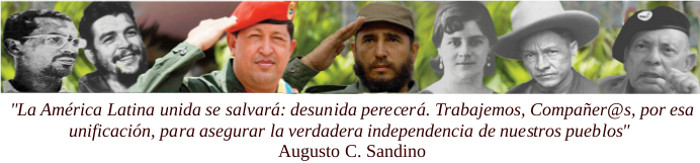
But for the sake of democracy and national sovereignty, we owe it to Ruben Dario, Sandino, and Carlos Fonseca, and to all the Sandinista revolution's heroes and martyrs, to give it a go.