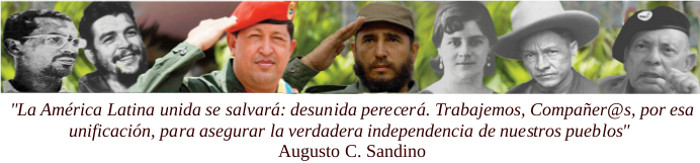
Interview with Compañero Carlos Fonseca Terán with Alberto Mora
En Vivo Magazine, Channel 4
February 21, 2019
We are pleased to speak this morning with Comrade Carlos Fonseca Terán, Militant of the Sandinista Front, thank you for allowing us these few minutes.
We wanted to speak, Carlos, on the occasion of the 85th Anniversary of the transit to immortality of the General of Free Men and Women. What constitutes the Figure, the Struggle and the Thought of Sandino today, but above all that thought gathered together by Comandante Carlos Fonseca Amador at the time, vindicating Sandino and taking him out of the ostracism in which the Somoza dictatorship wanted him to remain, and also the imperialist interests of Nicaragua?
Carlos Fonseca Terán
Thank you for this opportunity, Alberto. In fact, the first thing to point out about Sandino and his thought is that it is the fundamental basis of our political identity as Nicaraguan Revolutionaries, and that Carlos Fonseca was the one who had the capacity to see in Sandino our political identity as revolutionaries. Because Sandino was not only the defender of national sovereignty, but he was the anti-imperialist fighter; not only was he nationalist, but he was internationalist; not only was he a patriot, but he was also a revolutionary who fought for the transformation of Nicaraguan society, because he saw its injustice.
In one of his most important phrases, possibly the most important of all his phrases, he says: "My sword will defend national dignity and bring redemption to the oppressed. There he synthesizes the two aspects of his struggle: the defense of national sovereignty, and the struggle for social transformation, which furthermore he makes this clear in multiple writings and statements, such as, for example, when he speaks of the double exploitation suffered by the working class in Latin America: the exploitation of the national bourgeoisie, and the exploitation of the transnationals of Imperialism; when he also speaks of the irreconcilable character of class contradictions, between the exploited and the exploiters. Sandino speaks of all this.
Sandino identifies himself with the revolutionary approach that considers imperialism as the superior phase of capitalism, and declares himself an enemy of the capitalists. And he also says, because there is a myth there that Sandino was Liberal; Sandino says, "Liberals and Conservatives are a ball of scoundrels," and he also says, "Moncada made a deal in Tipitapa, that's where my liberalism was buried.”
He joined the ranks of the Liberal army, because the gringos have a confrontation at that moment, not at the level of the war, but the gringos consider that their interests are defended at that moment by the Conservatives. Then Sandino knew that from the Liberal ranks he could generate a revolutionary rovement that would first confront the gringos, which is what really happened; but then he takes the step, and says: Let's go against Liberals and Conservatives. In addition, Sandino said, "Let's eliminate the Liberal and Conservative Parties.
All this that I am telling you, that Sandino wrote or said, is properly verified and founded, and at some point I can get you where it comes from, what page, what book, what publisher, in what place and on what date it was published; because they are phrases of the General, they are his expressions.
For example, when he said that he was in favor of the land being outside the State and that in the conditions of Nicaragua he was inclined towards a regime of Cooperatives, and he said, "everything will be in cooperatives". That is to say, it is a revolutionary thought that has nothing to do with Liberalism... Is that clear? Liberalism is a defender of capitalism, and Sandino was an enemy of capitalism and spoke of the need for social transformation, he even went so far as to say that Communism is haloed with Freedom and that Jesus Christ was one of the great Communists of the Earth.
That is, if you know Sandino's thought, you can't be fooled into saying that Sandino was Liberal or that Sandino was not revolutionary. They wanted to sell us a Sandino free of everything that for the Right is sin, and nothing to do with it!
Now, there has also been a lot of manipulation of the issue that we call ourselves Sandinistas and we have been accused of kidnapping Sandino who is a national figure. It is not about kidnapping Sandino or appropriating Sandino; it is that Sandino appropriates our consciousness, it is Sandino who defines our revolutionary consciousness.
It is not that we are appropriating Sandino, but that we identify with Sandino's thought; because there are two things between which a clear difference must be made: one thing is to recognize in Sandino the national hero, defender of Nicaragua’s sovereignty , and who therefore deserves the admiration and respect of every Nicaraguan, and another thing is to identify with Sandino's political and ideological thought. They are two very different things.
So, every Nicaraguan has the moral duty to recognize his hero in Sandino, but not every Nicaraguan is obliged to think as Sandino thought; so those of us who do, are Sandinistas and that is why we call ourselves Sandinistas. Those who want to distort Sandino's thought are shameless barbarians who pretend to speak on Sandino's behalf but serve the interests of Imperialism.
In other words, there is nothing more contrary to Sandino than to serve as an instrument for the gringos, whom Sandino confronted with weapons in his hand, and whom he also denounced in his writings. Because Sandino also stated that his struggle had the objective of becoming a firm action of the masses, a firm anti-imperialist action of the masses on a continental level, a firm action of Masses against imperialism on a continental level, and worldwide, Sandino said. Sandino said clearly that he was confronting imperialism, and he also stated: "My ideal champions a broad horizon of internationalism"; that is, he made clear just what I am now saying to you.
In addition, a great merit of Sandino, little mentioned, was that in spite of not having studied, from the formal, academic point of view, not being a man with academic preparation, he was self-taught, a very intelligent man, he read a lot, and that must be an example for each one of us; a man who read a lot and that is why he managed to have a very interesting general culture, especially in the political field, which allowed him to feed from different sources so as to configure his revolutionary thought.
But the interesting thing I want to put to you is the following: how this man, without a great academic intellectual preparation, in the very difficult conditions in which he had to fight in the Segovia mountains, confronting, with a small army, the greatest military power in the world and in history, which was already an extremely strong and influential power at that time.
How in such precarious, difficut conditions, this man took the trouble to write so much; because Sandino wrote a lot of things, he wrote letters, proclamations, he wrote things all the time, and gave statements. To everyone who wanted to interview him, he would give statements, because that would help him spread the revolutionary ideas.
And when he says, "Our cause will continue to live," when he says, "If we die, it doesn't matter, our Cause will continue to live. Others will follow us", when Sandino says that, he is precisely thinking about the same consciousness that he expresses and demonstrates when he writes. Because he writes thinking precisely, that after his death the enemies of the people of Nicaragua will want to distort his thought and action; so then he leaves a written record, to prevent the Right, the enemies of the People from distorting his thought, and thanks to that vision he had, we can now state and demonstrate the revolutionary character of Sandino's thought.
Alberto Mora
Carlos Fonseca Amador picked up Sandino's Thought, also makes it known, and sets everyone in his circle to study it, didn't he?
Carlos Fonseca Terán
And he writes about Sandino's ideology, based on a compilation of Sandino's phrases that was used as study material for the Sandinista militancy for the fight against the Somocista dictatorship.
Alberto Mora
To distance oneself from the ideas of Sandinismo is to distance oneself from all that Sandino represents in Nicaragua’s struggle and the revolutionary and anti-imperialist Struggle. That is to say, it is incoherent to think that one can fight based on thought far removed from the ideas of General Sandino.
Carlos Fonseca Terán
Of course. That is to say, the revolution cannot be made if it is not made from the self-same reality that you want to transform with the revolution. And one of the most important things in Carlos Fonseca's vision was the ability he had to identify in Sandino the highest expression of political organization and the development of revolutionary ideas in history, in Nicaragua's own historical and social reality. The influence of the Cuban Revolution also contributed to this, the triumph of the Cuban Revolution in the first steps taken by the Sandinismo already organized by Carlos Fonseca, given that the Cuban Revolution inaugurated a new era in our continent’s revolutionary struggle.
In the first and second Declaration of Havana in 1960, which was a strategic guide for Latin American revolutionaries, Zapata from Mexico, Martí from Cuba, Bolívar from Venezuela and Sandino from Nicaragua are mentioned as the main heroes in the continent's struggle for freedom. That powerfully caught Carlos Fonseca's attention and corroborates what was already analyzing about the need to have a political identity of one's own as Nicaraguan revolutionaries; and it also draws inspiration from Fidel's statements after the assault on the Moncada Barracks, when taken prisoner, he was asked who was the intellectual author of the action, and he says José Martí, who had died half a century earlier.
So that is what it is, to have as a reference the same reality of the struggle of the People to which one belongs, in order to be able to make the Revolution.
Alberto Mora
Bearing that in mind, in international meetings you have had the opportunity to participate in events of the Left, of political parties and also doing solidarity work. In that sense, there is a worldwide recognition around Sandino's achievment, the example of Sandino and the Sandinista Revolution, the Second Revolution of Latin America.
Carlos Fonseca Terán
Of course! It is a highly significant fact that the Sandinista Revolution was the only triumphant Revolution after the Cuban Revolution, and the only one on mainland Latin America; when there were theses that said that Cuba was an exception because Imperialism could no longer be surprised.
However, here we did what we had to do, what had to be done was done, and the Revolution triumphed against many predictions, even at the level of what were the revolutionary movements that put into practice the armed struggle in Latin America, the Sandinista Movement was not the most outstanding, the most promising, the one with the greatest possibilities of triumph; However, it was the one that triumphed, based on the vision, the capacity, the wisdom that the Sandinista Front had, to define the correct strategy so as to achieve leadership in our nation’s popular struggle.
Alberto Mora
Thank you very much Carlos.