
NICARAGUA's PROPOSAL IN THE UNEA 4:
GLOBAL MOVEMENT TO ACHIEVE SURVIVAL THROUGH A SUSTAINABLE ZERO-EMISSION SOCIETY
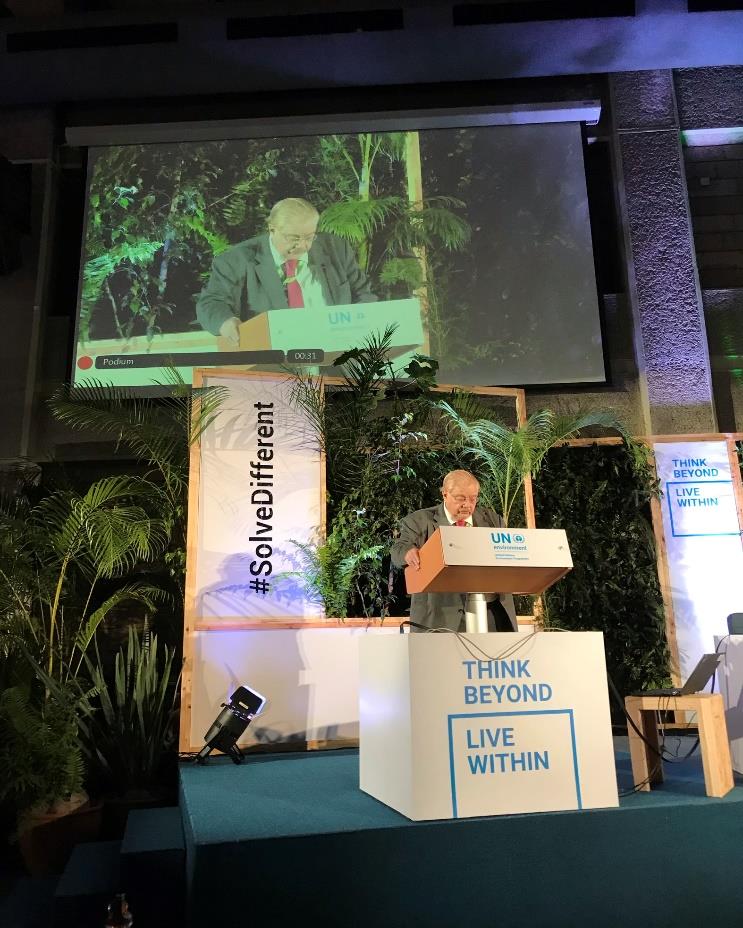
During Nicaragua's intervention in the United Nations Fourth Environment Assembly (UNEA4), condolences and solidarity were offered to the loved ones of the victims of the air tragedy on Sunday, March 10th. Minister-Private Secretary for National Policies of the Presidency Dr. Paul Oquist who represents Nicaragua at the UNEA4 offered condolences on behalf of President Daniel Ortega Saavedra, Vice President Rosario Murillo Zambrana, the Government of National Reconciliation and Unity and the people of Nicaragua.
He went on to maintain that the most important question in the 21st century is whether our civilization will be able to survive the ongoing climate change and existing nuclear weapons. The 1.5°C IPCC Report tells us that the road to survival is to reduce emissions by 40% by 2030, and achieve a zero-emission sustainable society by 2050.
It also teaches us that the difference between 1.5°C. and 2.0°C. is exponential, as shown by the increase to 2°C. The extinction of corals and the acceleration of the melting of the arctic permafrost by 38%, releasing methane gas 20 times more harmful than CO2.
Dr Oquist pointed out that limiting the increase in the average temperature to l.5°C. above the pre-industrial level implies strong economic, social and political transformations that are opposed.
After the Paris Agreement there has been an increase in lobbying for hydrocarbons and denialist positions, which have even gained political spaces of great power.
Today we are debating whether public policies should be based on science or greed, with greed still predominant. Achieving a sustainable zero-emission society implies profound transformations in the defense of life against the supreme immorality of causing extinctions.
Nicaragua's proposal is a worldwide movement for survival. In recent centuries the great victorious social transformations of morality over powerful hegemonic interests have been the result of millions of people in different sectors and countries, with different methods, fighting for a clear common goal: Abolish slavery, independence from colonialism, labor rights, suffrage for women, civil rights.
What we need is a global movement for survival. It takes social pressure to forge political will.
******************************
ADDRESS TO THE FOURTH UNITED NATIONS WORLD ENVIRONMENT ASSEMBLY
Dr. Paul Oquist Kelly, Minister-Private Secretary for National Policies Presidency of the Republic of Nicaragua
Thank you very much, Mr President,
President Daniel Ortega Saavedra, Vice President Rosario Murillo Zambrana, the Government of National Reconciliation and Unity and the people of Nicaragua extend our deepest condolences and solidarity to the loved ones of the victims of last Sunday's air tragedy.
The most important question in the 21st century is whether our civilization will be able to survive the ongoing climate change and nuclear weapons. History teaches us that the first civilizations with central governments, the Akkadian Empire in Mesopotamia and the Ancient Kingdom of Egypt, entered into crisis 4200 years ago due to droughts of 100 to 300 years caused by climate change in the form of an ice age.
Since our climate change is anthropogenic, we can act on the causes rather than just adapt to the consequences. The IPCC Report on 1.5°C. teaches us that to achieve the goal we must reduce emissions by 40% by 2030, and achieve a sustainable zero-emission society by 2050. It also teaches us that the difference between 1.5°C. and 2.0°C. is exponential, as shown at 2°C. by the extinction of corals and the 38% acceleration of Arctic permafrost melt, releasing methane gas 20 times more harmful than CO2.
The warnings of the IPCC have not yet been translated into action. Even after the Paris Agreement there has been a rise in lobbying for hydrocarbons and denialist positions, which have even gained political spaces of great power.
Today we are debating whether public policies should be based on science or greed, with greed still predominant, supported by two subjective alienations that I identify in my book "Equilibra":
* First, the belief that there can be endless, limitless and meaningless increases in production, consumption, accumulation and concentration of capital on a planet with finite resources, that is wild capitalism.
* Second, the belief that it doesn't matter how much damage we do to the ecosystems that sustain life on Planet Earth because science and technology will always save us, that is, messianic scientism.
Achieving a zero-emission sustainable society implies profound transformations in the defense of life against the supreme immorality of causing extinctions.
What we need is a global movement for survival. In recent centuries the great victorious social transformations of morality over powerful hegemonic interests have been the result of millions of people in different sectors and countries, with different methods, fighting for a clear common goal: Abolish slavery, independence from colonialism, labor rights, suffrage for women, civil rights. Social pressure is required to forge the political will necessary to carry out the great transformations.
Thank you very much, Mr President.