FR. MIGUEL D’ESCOTO, MM (1933-2017)
Memorial Service, Maryknoll June 20, 2017
Robert Ellsberg
Unlike many of you, I was not a close friend of Miguel. But I have spent most of my life living and working in the house that Miguel built—and so, along with many colleagues, I regard him as our Father Miguel.
 In the history of Maryknoll, and of the wider church, there is no doubt that Miguel D’Escoto occupies a unique place. He was not only a priest, a missioner, and peacemaker, but also a revolutionary, a statesman, a diplomat—a beloved son of Maryknoll, and no doubt a source of sleepless nights to successive Maryknoll Superiors, who nevertheless stood behind him (and held him close to the Maryknoll family.) Before serving as president of the General Assembly of the United Nations, he was one of several Nicaraguan priests who served in the Sandinista government--in his case as Foreign Minister—and as a result was deprived by the Vatican of his priestly faculties.
This was a mission beyond the reckoning of Frs. Price and Walsh.
But today it is for another one of Miguel’s initiatives that I would like to remember him—one that lives on, not on the world stage, but here at Maryknoll.
I first heard Miguel’s name in 1976 when I was a member of the Catholic Worker community in New York, where we used to divide up the task of writing thank you cards to our benefactors. One day I found myself writing such a note to Fr. Ernesto Cardenal in Nicaragua. To my surprise, he sent me a personal reply, writing, “You ought to go up to Maryknoll and meet my friend Miguel D’Escoto.”
Regrettably, I didn’t follow up on that suggestion. But a few years later I found myself studying Spanish at the Maryknoll language school in Cochabamba. And there in the library I discovered my first Orbis books—starting with Leonardo Boff and Jon Sobrino, and working my way up to Gustavo Gutierrez. I felt like one of the disciples on the road to Emmaus, when they heard Jesus explain the scriptures anew and felt their hearts burn with them.
That encounter led me to study theology and ultimately, in 1987, it led me to Maryknoll to serve as editor-in-chief of Orbis—the house that Miguel founded in 1970.
It was a few years later that I recognized Miguel walking around in front of the Walsh building and summoned up the courage to introduce myself. I invited him up to our office and there he was happy to reflect on the origins of Orbis Books As he recounted, Maryknoll had dabbled off and on with publishing books. But as the Director of Social Communications he felt the time had come for a new kind of publishing venture—dedicated to amplifying theological voices from what was then called the Third World.
What was happening at the time to make him think this was the hour for such a venture? It was 1970, two years after the historic meeting of the Latin American bishops at Medellin, an event that fundamentally realigned the mission of the church from the perspective of the poor. Miguel could see the implications of this event for the wider church. Christians in the Third World were finding their own voice, reading the signs of the times and interpreting the gospel from below, from those on the margins. Miguel too was reading the signs of the times. Here was an opportunity to evangelize the rich of North America through the voices of the poor.
Nevertheless, it was a risky venture. The Council was divided. Miguel gave special credit to Fr. John McCormack, the Superior General, for giving the go-ahead and agreeing to subsidize the project. Miguel went on to recruit Philip Scharper, a legendary Catholic editor. And he personally set off on a trip throughout Latin America to collect manuscripts from the best of the emerging figures in liberation theology.
Among these was Gustavo Gutierrez’s A Theology of Liberation, published in Spanish in 1971, translated by Orbis in 1973. It has sold well over 100,000 copies and it was cited by Christianity Today among the 100 most important Christian books of the 20th century. Books from Africa and Asia followed. And soon Orbis was being recognized as an essential conduit for Third World theology—not just liberation theology, but books on interreligious dialogue and inculturation, changing forever the terms of theology and mission.
2020 will mark the 50th anniversary of Orbis Books. Now, in this era of Pope Francis, it is easy to forget how much faith and courage it took for Maryknoll to stand behind our program. Many Maryknollers have been kind enough to say that they regard Orbis as one of the most successful and influential mission projects that Maryknoll has sponsored.
And when I hear such accolades, I have to think, with gratitude, of the vision and creativity of Miguel D’Escoto. And it makes me wonder what it would mean to show a similar vision and creativity in facing the mission challenges of our time.
I remember that afternoon years ago in our office. As he looked over our current list of books and the 1000 titles in our vault, he told me that one of his proudest accomplishments was the founding of Orbis Books. "Everything I have accomplished," he said, "has come from being able to dream big dreams, and then finding people who would share those dreams."
Of course Miguel’s dream of Orbis was just one step in his prophetic, journey. Ultimately, he staked that mission and his priestly vocation on the cause of the poor. Often he attributed that choice to his reading of the story of the Good Samaritan.
“Like the Good Samaritan,” he said, “and the priest who went ahead and the other religious man who followed him, I was on the way to Jericho. My life had a very specific agenda. I had my work cut out for me, but all of a sudden the unexpected happened, There was my follow countryman bleeding by the roadside, and I had to get off the beast and forget, for the time being, going to Jericho.”
Miguel put his priesthood at the service of his people, the poor of his country, who were lying in the ditch.
It led him into politics and diplomatic service, a path that was deemed inconsistent with his priestly vocation. There is no doubt, however, that Miguel was motivated by his deep identification with the gospel of Jesus—who undoubtedly learned from his Blessed Mother her revolutionary prayer to a God who “fills the hungry with good things,” and “sends the rich away empty.”
Returning again to the Good Samaritan story, he noted, “The will of God is manifested not only in the will of superiors . . . The will of God appears in relationship with history: it arises out of history itself. Many times it leaps out onto our path just when we’re on our way to carry out our scheduled work, our programs. God leaps out into our path with unforeseeable things, things that take us by surprise—especially our neighbor, God’s wounded people, God’s and ours. I had to leave the beaten path of my usual missionary activity. I had to follow the example, not of the priest, but of the Good Samaritan. I had to do this, out of fidelity to Christ and love for my people—which aren’t different things. They are one thing—one faith, one love, one cross.”
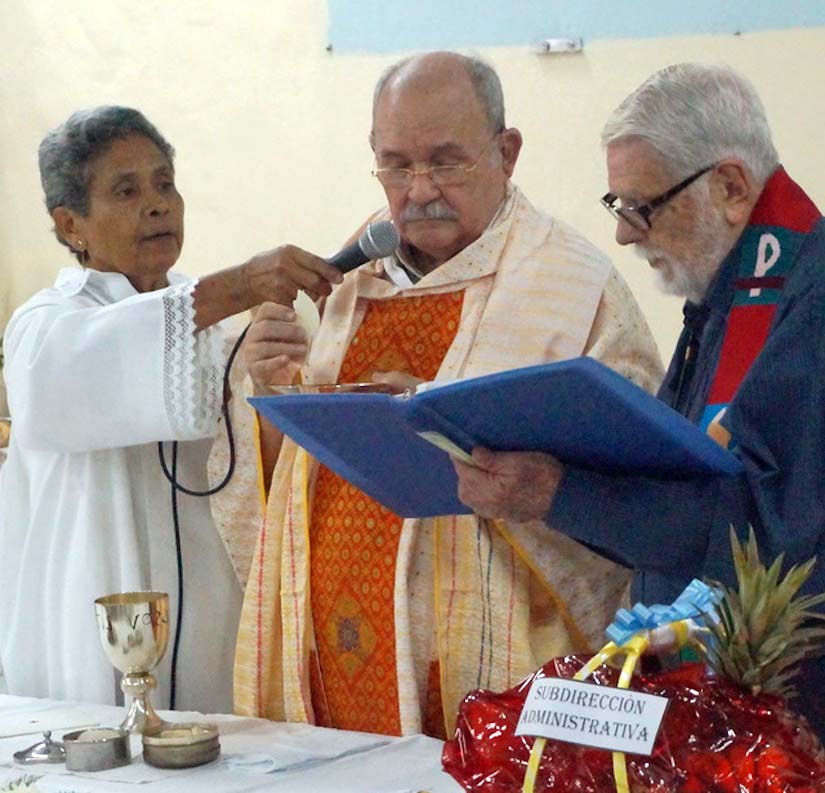
When asked whether he looked forward one day to resuming his sacramental priesthood--which occurred, thanks to Pope Francis, three years before he died--he said:
Yes, but I am perhaps living that Mass now, with the pain, even more than if I did not have this difficulty. . . It is precisely in my fundamental commitment to living the Mass that I accept this prohibition from celebrating the Holy Sacrifice. Our Lord says, "Do this in commemoration of me." He did not mean that we repeat the words only, because we are not parrots, but that we repeat those words as human beings; that is to say, that we take on the inner dispositions that He had when He said, "This is my body and this is my blood." We make those inner dispositions our own, and then we say the words, because we speak as human beings, conveying what we feel.
So, to live the Mass is to have that inner disposition of availability to God, including the giving of your life for the service of the people, and to ask to be strengthened in your love for the cross and the acceptance of the cross in whatever shape or form God decides you should carry it.
In later years Miguel often sent requests for books we had published—particularly on ecology. He frequently expressed fatherly pride in what we had achieved. Recently he asked for my help to obtain photographs of the founders of Maryknoll, saying that they were much in his thoughts and prayers. He asked for an icon of Our Lady of the Apocalypse that we had published.
It inspired him to write this prayer to Mary:
“You labor to give birth to the Prince of Peace
in what is an ongoing process of birthing Him,
first in your own soul and in the world through you, and now in each of us,
till, with Paul, we’ll all be able to say:
I live no longer I, but it is Jesus who now lives in me.”
Miguel spent his life in service to the poor and to the Prince of Peace, struggling to give birth to a better world. I thank him for showing me my own work and vocation. May he inspire us now to dream big dreams, to follow more faithfully the path that God has set before us, always ready to step off the beaten path, to accept the surprises that confront us, especially in the needs of our neighbors. And may Miguel know the peace that passes all understanding.