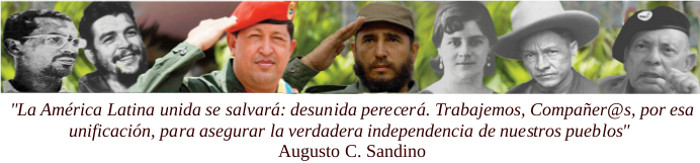
DANIEL : "Sandino, a son of Bolívar who vindicated Bolívar's Supreme Dream for the Unity of the Peoples of Latin America and the Caribbean"
Submitted bytortilla
onMar, 19/05/2020 - 10:06
Commemoration of the 125th Birth Anniversary of the General of Free Men and Women Augusto C. Sandino
May 18, 2020
Remarks by Daniel
Good afternoon, Nicaraguan Sisters, Nicaraguan Families, here we are with Compañera Rosario, Vice President of the Republic; with Dr. Gustavo Porras, President of the National Assembly, and with Dr. Martha Reyes, Minister of Health.
Today, May 18th, we must first talk about the 125th anniversary of the birth of our General Sandino, and remember Sandino, pay homage to him on this day, on this date, doing so in the name of the People of Nicaragua and especially so since, just as General Sandino organized the Army for the Defense of National Sovereignty, here the Nicaraguan People are organized in the battle for life in the fight against this coronavirus pandemic.
And at the forefront of this battle, we can say, is this army of doctors and nurses, of health workers who every day, in their work as doctors, as nurses, as health workers, are caring for patients who come in with different types of diseases, which are transmissible too, and the doctors, nurses, health workers take on these risks, and given the circumstances in which we are facing this epidemic, with even more reason do we acknowledge, in tribute to our General Sandino, the health workers who are fighting this battle with courage, with dignity, with a great spirit of solidarity, in a very Christian spirit.
We salute Blanca Segovia, daughter of our General Sandino, also the grandchildren, great-grandchildren, and all the family of our General Sandino, on this 125th Anniversary in which all our country, the whole country has paid homage to the General of Free Men and Women, Augusto C. Sandino.
We are grateful for the messages we have received, and we are grateful for the message from our brother Nicolás Maduro, who commemorates this epic achievement with us. Sandino, a son of Bolívar who vindicated Bolívar's Supreme Dream for the Unity of the Peoples of Latin America and the Caribbean, which later, thanks to Comandante Hugo Chávez, became a reality in the form of the Community of Latin American and Caribbean States, the CELAC.
As time has gone by, as the years have gone by, as centuries went by, this Community of Latin American and Caribbean States that today we have to defend became a reality, so that it can be strengthened and efforts united to address different issues that figure in the agenda Mexico currently presides over, the agenda of the Community of Latin American and Caribbean States.
We remember that on this date in 1895, the General was born in Niquinohomo; in 1960, Edwin Castro, Cornelio Silva and Ausberto Narváez were assassinated by the Somoza Dictatorship; then we also remember on this date the first combatants of the Front met on the Patuca River; and in 1980 the People's Literacy Army brigadista, Georgino Andrade, who was 28 years old, died. Let us remember Georgino also on this day, who followed in the footsteps of Sandino, who was to bring education to rural families, to working people.
And on the 21st of September that I mentioned to begin with, was the execution in which Rigoberto López Pérez fell, in that act of administering justice. And then, Edwin Castro, Cornelio Silva and Ausberto Narváez were arrested, captured and tortured. They spent long years in prison, and then they were murdered on a day like today, May 18th. Why? Because they had been linked to Rigoberto López Pérez, hero of the Fatherland...
Returning to the subject of diseases now affecting the world and, in particular, Nicaragua, we have the following data: first, deaths from pneumonia, because at the moment, linked to the coronavirus, there are many deaths from pneumonia as well. Why deaths from pnemonia? Because the person was already suffering, or in a state propitious for pneumonia; an influenza, an H1N1 can lead to pneumonia, a poorly cared for, poorly attended influenza, we might say.
So, here we have the table of deaths due to pneumonia, for the period January 1st to May 15th, from the year 2015 to the year 2020. In 2015 we have 302 deaths due to pneumonia; in 2016, 329, which is the highest point in this table of deaths due to pneumonia; you can see without having an epidemic like the current one, 309 deaths due to pneumonia. In 2017, 289; in 2018, 215 deaths due to pneumonia; in 2019, 222 deaths due to pneumonia, and in 2020, again 309 deaths due to pneumonia of which some undoubtedly have to do with the pandemic. In other words, the highest point was in 2016, 329; secondly, now in 2020, 309, and thirdly in 2015, with 302 deaths from pneumonia.
This is in order to understand how we are facing this pandemic and how we have managed to counteract it, although of course, on the other hand, we also have the normal cycle of deaths due to pneumonia, and by no means all of these have to do with the coronavirus.
And today, at the World Health Organization meeting, Nicaragua made a presentation showing how, based on our reality and our economic and social order, we have been addressing this epidemic, caring for and defending the lives of Nicaraguans by applying the basic standards established in national and international medical protocols. And well, also a little following the experiences of other countries, observing them, following them, why? Because there are experiences of all kinds, there is still a lot of discussion on the subject, there are many differences on the subject, but each country, according to its reality, its economic and social conditions, applies practices to defend the life of its citizens.
And, faced with this pandemic, because we continue to face it and, indisputably, we cannot lower our guard... tomorrow the Ministry of Health will give the data, the report for last week, we have to continue addressing an issue that has to do with economic activity, with production, with education, with trade that is basic for the country to sustain itself.
And in this regard we have at this time a very difficult situation, a difficult situation that unfortunately has been created by the Costa Rican authorities, and has to do with the transit of food, raw materials, both imported products and products that are exported.
That movement of goods goes from Guatemala to Panama and from Panama to Guatemala, passing from Panama to Costa Rica and then through Honduras, El Salvador, and arriving in Guatemala. That transit was moving quite smoothly, very smoothly; that is, this Central American regional trade route was not being affected, and meetings had even been held. We began with a meeting of the SICA Presidents, and, well, everything was going well, nobody raised a problem in this regard; also other bilateral meetings with Costa Rica, and everything was going well, considering aspects of migration, of security.
During these months, thousands of shipments of freight, food and raw materials were moved here from north to south and from south to north, from Guatemala to Panama and from Panama to Guatemala, without any hitches, while maintaining basic, minimum standards established from a health standpoint, and, of course, the standards set by the customs authorities of each country, and there were no long lines of vehicles.
What has happened in the last few days? The Costa Rican authorities started to impose unilaterally, that is, there was no call to discuss the issue, they simply made decisions that resulted in the closure of the borders. In other words, it is Costa Rica that has closed the borders, with what? With the measures that it began to take, to demand, and began to put in place.
So that is why, right now, between Peñas Blancas and Rivas, we have 384 transport units from Guatemala, which have not been able to pass through to Costa Rica; 284 transport units from El Salvador, that is, they have traveled from Guatemala heading for Costa Rica, heading for Panama, the Guatemalans, 384, there they are, unable to pass through. From Nicaragua there is no problem for them pass, it is Costa Rica that is blocking the passage of 384 Guatemalan transport units, 284 transport units from El Salvador; 62 transport units from Honduras; 92 transport units from Nicaragua that are there waiting to pass to Costa Rica, and others to Panama; 103 transport units t from Costa Rica, they themselves have blocked their own transport units; 16 transport units from Panama. That is, a total of 942 transport units queueing there. People passing by can see the enormous queue between Peñas Blancas and Rivas.
And at the other border crossing at San Pancho, not far from San Carlos, Rio San Juan, there are 8 transport units from Guatemala, 12 transport units from El Salvador, 1 transport unit from Honduras; 4 from Nicaragua; 39 from Costa Rica; 4 from Panama, for a total of 68 transport units.
The grand total of these transport units there, not allowed to pass into Costa Rica is 1,010 transport units.
So it is not Nicaragua that has closed its customs office so as to prevent these transport units from passing through. It is Costa Rica that has closed the passage with the measures that it has been taking, and even worse with the measure that it took today, a decree which has provoked a reaction in all of Central America: reaction on the part of the Central American transport organizations, reaction from business people, Central American business people, reaction from Costa Rican traders and business people who do not agree with the measure, as they have made clear to us all publicly.
This is information published in Costa Rica. It says: "San José. The Advisory Committee on Economic Integration requested the Costa Rican government to reconsider its decision to limit the entry of foreign transporters to avoid outbreaks of COVID-19 on its borders”. Because that is Costa Rica's pretext. Then, today there was a meeting and in the meeting all the Central Americans proposed that those measures that Costa Rica had approved had to be lifted, because that simply did not allow the passage of transport.
The approach of the regional private business sector, also inrelation to the implementation of unilateral actions, indicates that Costa Rica's executive decrees will have a negative impact on the regional supply of essential products, including those for combating COVID-19, and on adequate access to food for the population. In other words, it is affecting them as well.
Supported by 17 groups from all the Central American Nations at the meeting held today at 10 a.m., the proposal calls on the countries of the isthmus to support the urgent drafting and immediate application of the protocol for the Central American transport sector, which will establish coordinated procedures among the States to prevent contagion and ensure the flow of trade, and not, contrariwise, to impose or try to impose mechanisms on transport, which rather block transport, when what is needed is, well, greater coordination, since we are all fighting this pandemic.
There have already been meetings of the Central American Ministers of Health as well, dealing with the issue of the pandemic. The important thing is that, in fighting the pandemic, we do not create another crisis and pandemic with a humanitarian impact, one ultimately affecting the Central American population.
We ratify our willingness to continue facilitating international land-based customs transit of freight, in coordination with other national and regional institutions, in order to standardize efforts that will enable us to provide prompt attention at border control posts. That is Nicaragua's policy; in other words, it is not up to us, it is up to Costa Rica to be willing to talk and to find a mechanism that will provide security for the freight carriers themselves.
Look at what the President of Costa Rica's Chamber of Industry, Enrique Egloff, says "it is a regrettable situation", after the Minister of Health of Costa Rica spoke about why it is necessary to apply this measure.
"It is a regrettable situation, the Minister forgot to mention that the border with Panama is also closed because of a strike by freight operators", because the freight carriers have reacted there in Panama by blocking the border with Costa Rica, "because coincidentally that is the basic problem, and the basic problem is that we must understand that 85% of the freight carriers are owners of their transport unit or tractor unit and in that sense I simply ask three questions because we put on the table in the discussions with health authorities, and last week thanks to the kindness of the Minister of Foreign Trade, we had the opportunity to share with health authorities particularly with Mr. Rodrigo Marin, we explained to him that we had to look for an appropriate medicine to attend the patient, the patient that Costa Rica is today, immersed in world trade and that 20% of our trade is with Central America, Panama is closed and Nicaragua is closed; in that sense, trade is closed, the borders were closed because of a decision that was taken, for better or worse, and of course we firmly support all the Measures that are being adopted in the matter of sanitary control, but I ask three questions, in Costa Rica as it happens and in Central America because of what already explained and it is a reality, 85% of freight carriers own their transport unit or tractor unit, so switching units is not viable! ”. Because they are talking about switching to Costa Rican transport the containers from Guatemala, El Salvador, Nicaragua and Honduras.
So he says: "Switching units is not viable! Who will be given the tractor unit with the trailer? Who will take responsibility for the content or what is missing in it? Who will be responsible if there is contamination of the container, or if drugs are found? The control chain is broken, to cite an issue of cost and of enormous importance, apart from logistical complexity, those of us who export to the North, for example to Guatemala, would have to hire 4 drivers, one per country, to get to Guatemala, in Costa Rica we do not have conditions to handle switching units, to handle the containers and transfer them from one unit to another, that is not viable! So why do we still face a situation that is not viable? We think there must be a solution but that solution is not to keep the borders closed, there is an urgent need to act or we will enter an economic pandemic.
"Here especially the small and medium sized companies that depend on their trade in Central America are already suffering the consequences..." Of course! if there are more than 1,000 transport units there unable to pass through, "and those consequences I believe large part are because our proposals were not taken into account".
So, we want to call on the Government of Costa Rica to work as quickly as possible, based on the agreements made today at the meeting. You see, we will have to wait 7 more days with those transport units standing still there, at least, why? Because,as Costa Rica's representative said, they are talking about 7 days from now. Since she could not make any decisions, she said a Commission would meet in seven days' time to begin to see how to adress this issue, how to regulate this transport issue and allow it to flow as it had been doing, without weakening the measures each country has in place to combat the pandemic.
This is the call that we make to the Costa Rican Government, we are entirely disposed. Meanwhile, to the transport workers who are now along the Rivas isthmus and those over in the department of Rio San Juan, we express our Solidarity to all these transport workers, and we hope that on this issue we will have the agility, the speed to give a timely response Because there are also products that are perishable and the longer they are there, those products will be lost, and the freight carrier loses, the trader loses, and the ones receiving that perishable product lose, who would have been supplied, because they will not be able to receive it, and the cost of that product will increase in the market, becoming more expensive because it will be more scarce. So, this is the appeal we make to the Government of Costa Rica so as to overcome this situation.
And on this 125th Anniversary of the birth of our General Sandino, our commitment is to continue fighting, fighting for Life, fighting for Peace for all Nicaraguans, together with the Central American sisters and brothers, together with the Latin American and Caribbean sisters and brother, together with the world community.
Thank you and good night Nicaraguan brothers and sisters.
 Remarks by Daniel