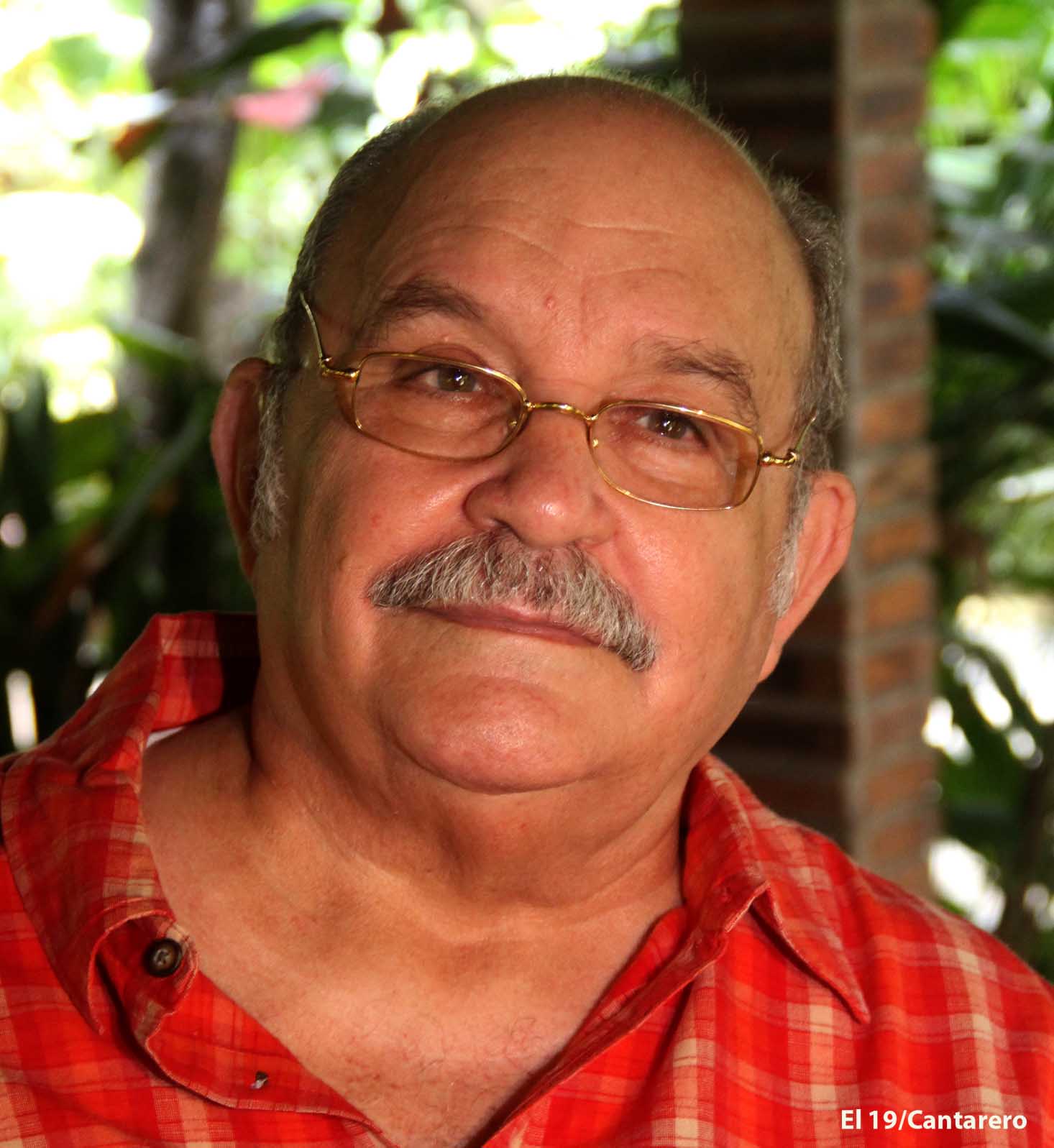
On the Third Anniversary of the Passing of Father Miguel d’Escoto Brockmann
Remarks by Sofía M. Clark at the memorial ceremony held at the UNAN-Managua
8 June 2020
Versión español en formato PDF
Good morning and warm greetings to all who are here—either in person, virtually, or spiritually.
I must first express my condolences to the UNAN university community on the loss of some of our brothers and sisters, which brings us great sorrow. To those who are sick in our country and beyond, we wish you a speedy recovery. I also wish to acknowledge that since Holy Week, the religious order in which Father Miguel d’Escoto served, Maryknoll, has lost more than 40 members. My condolences to Maryknoll as well.
I will keep my remarks short since we have had so many speakers today, but I wish to highlight two things.
We know that three years ago Nicaragua lost one of her greatest national heroes, and for many of you here, we lost a brother, a colleague, a mentor, a friend. And humanity lost one of its greatest defenders.
Also today, June 8, exactly 12 years ago our beloved Father Miguel was elected President of the 63rd Session of the United Nations General Assembly. This is why I think this is a good opportunity to reflect a bit on his period at the UN.
Like every task Father Miguel performed, he took great pains to prepare himself, and rightly so. He devoured books, sought advice, and practically memorized verbatim Paul Kennedy’s book The Parliament of Man: The Past, Present, and Future of the United Nations. Father was more aware than anyone else that the UN’s prestige was at an all-time low. Though he was always one of the UN’s harshest critics, he never stopped being its most ardent defender.
I wish to tell you a brief but illustrative anecdote. Several people today have mentioned Father Miguel’s message of international solidarity, of loving one’s neighbor, and of evolving from a logic of “me and mine” to one of “we and ours.” He had a meeting in the early days, before his presidential term formally started when he was meeting with various regional groups. One group is called GRULAC which includes Latin America and the Caribbean; another oddly named group is called Western Europe et al. Those “et al” are quite interesting, but that’s another story.
So when Father gave his spiel about how he sought to democratize the United Nations he also spoke of the need for Supreme Love to characterize interactions between people and between countries. It was then that the dean of the group spoke—a large, strong, very self-assured man from Iceland. He said, “What I just heard sounds more like a sermon than a political message… [pause] but perhaps that is exactly what we need.”
And I am telling you this because Father Miguel never stopped being Father. It was impossible to meet him and not realize this. He never wanted to do what was politically correct, but what, as a priest, he considered to be religiously correct.
So, as Paul Oquist just told you, when Father arrived at the UN he was already quite aware… he said that 16 major world crises were converging at that time, including a food crisis, a poverty crisis, the climate crisis, the nuclear weapons crisis. He spoke of all that and started his term with an ambitious proposal to democratize the United Nations. In his mind that meant organizing a series of special assemblies to discuss: What is the role of the General Assembly? Why aren’t its decisions binding? What should the role of the Security Council be? What should the role of the Bretton Woods institutions be?
The financial crisis that shook the world erupted right as he was assuming his post as President, and it totally displaced his agenda. But Father Miguel did not resent that.
On the contrary, he was able to see a great opportunity in that moment, an opportunity to involve all the world’s nations—the G192 at that time—in a global conversation and an opportunity to reposition the General Assembly.
I must confess that not everyone was able to make that leap.
His fight to obtain international support for the Summit on the Global Financial and Economic Crisis would leave a lasting impression. It was an experience that showed Father Miguel what little hope and expectations people had for the global organization. They were determined to go back to their regional blocks, in lieu of the United Nations, to address their concerns—even to help them survive.
But Father Miguel also understood that no matter how important and necessary the regional blocks were—and he did embrace them, promote them, and encourage them—they were not a substitute for worldwide action.
After his year as President of the UNGA he served on the Advisory Committee of the UN Human Rights Council in Geneva where he worked on the People’s Right to Peace. There he met privately with some friends, ambassadors from ALBA countries, who asked him about the Summit on the World Financial and Economic Crisis from the previous year. He told them, “I must confess, in all honesty, that we missed the boat on that one.”
I am telling you this because I think that right now we are again facing what could be a turning point. The pandemic has shown everyone just how inter-connected and interdependent we are. It touches us all, no matter who we are or where we live. And we could see this as an opportunity to take collective action, if only we can muster the resolve.
But here, today, I wish to point something else out. In this very venue on one of Father Miguel’s last visits to this university he said, “To tell you the truth, the UN is no longer just useless, it is no longer just dysfunctional—that is, incapable of achieving the purposes for which it was created—now it is also the main instrument of death at the service of genocidal imperialism.”
I am telling you this because you must understand his enormous frustration. This was in a speech Father Miguel gave in May of 2011. He had just launched his proposal Reinventing the UN and he had [recently] been sent by President Daniel Ortega to New York to help, that is, to try to avoid a further escalation and intervention by the United States and NATO, with the blessing of the United Nations, in Libya.
This greatly impacted Father Miguel’s decision to include one of the most innovative aspects of his Proposal for Reinventing the United Nations, and that was to include, as an integral part of the Charter, the absolute abolition of war as a means to resolve conflicts [between nations].
His work for the People’s Right to Peace with the Advisory Committee of the Human Rights Council made a deep impression on him. I think it is important, we make a point of often mentioning the suit Nicaragua brought before the International Court of Justice at The Hague. We stress how important it was to lay the foundation for non-aggression, [the proscription of the use of force]. But I tell you that today we need to study how these core concepts of international law are being rolled back more and more every day.
We have all become, each one of us, accustomed to war. We do not question it and we do not stop it. Even today we see meetings of the UN Security Council to discuss aggression and threats of the use of force against Venezuela. And the whole world holds its breath to see whether oil tankers coming from Iran will be able to reach and enter Venezuela’s territorial waters to bring aid to a people in dire need, a nation that has friendly relations with Iran and has the right to conduct trade with that country. When it comes before the Security Council and attempts to simply reaffirm basic principles of the UN Charter, the United States will not allow it. It uses its veto. There is no relief, there is no one who can defend Venezuela there. There is no relief, there is no one who defends Venezuela (not that there is no one), but the Council as such is not capable of providing real support or protection.
This is interesting because Nicaragua did the same thing after the ruling by the World Court. We also went to the Security Council. In fact, we went repeatedly. And we not only proposed resolutions to make the U.S. abide by the ruling of the Court, but also to uphold the principles of the UN Charter.
So now the world is worse off. When Father Miguel spoke of the abolition of war, he was not the first to do so. This concept had been discussed long before the founding of the United Nations. But Father Miguel’s view was quite innovative in that it was all-encompassing because he also spoke of the demilitarization of the UN. He said, “If we are going to overcome violence, let’s start with the Organization itself.”
As long as we lend any ambiguity or some sort of [justification of war as] a tool, they will persist, and we will never break the addiction, of certain Member States of this Organization, to war. They devote hours to this, and they allocate resources, and they discuss it, and it is even a business for them. Because those same warlords sell all the equipment used by United Nations peacekeeping missions, which are usually sent to clean up the disasters they have created with their wars of aggression.
I stress this because it is fundamental. These are not the harebrained digressions of an old man, nor were they altruistic thoughts. It was a recognition that as long as the UN allowed this to happen, the agenda of the world’s people would be held hostage to these warlords.
And finally, when Father Miguel discussed the need to take back and democratize the United Nations, he said “We must act—not tomorrow or sometime in the future. We must act right now. Today.”
Thank you.